By the end, you can…
- Calculate magnitudes, unit vectors and scalar products.
- Connect projection to perpendicularity.
- Use a vector product to find a normal and a plane equation.
Skills to bring
- Two-dimensional vector arithmetic
- Pythagoras and cosine
- Coordinates in three dimensions
01 · 8 minutes · Start without a calculator
Warm up
Try these in your notebook. Use the answers to spot anything to revisit.
Find ∣(3,4)∣.
Show worked answer
5
32+42=5.
Calculate (1,2)+(3,−1).
Show worked answer
(4,1)
Add corresponding components.
Calculate (1,0)⋅(0,1). What does this tell you?
Show worked answer
0; the nonzero vectors are perpendicular.
The scalar product of perpendicular vectors is zero.
02 · 12 minutes · Think, then discuss
A direction perpendicular to two others
Let a=(1,0,1), b=(0,1,1) and n=(−1,−1,1). Use calculations and the diagram together.
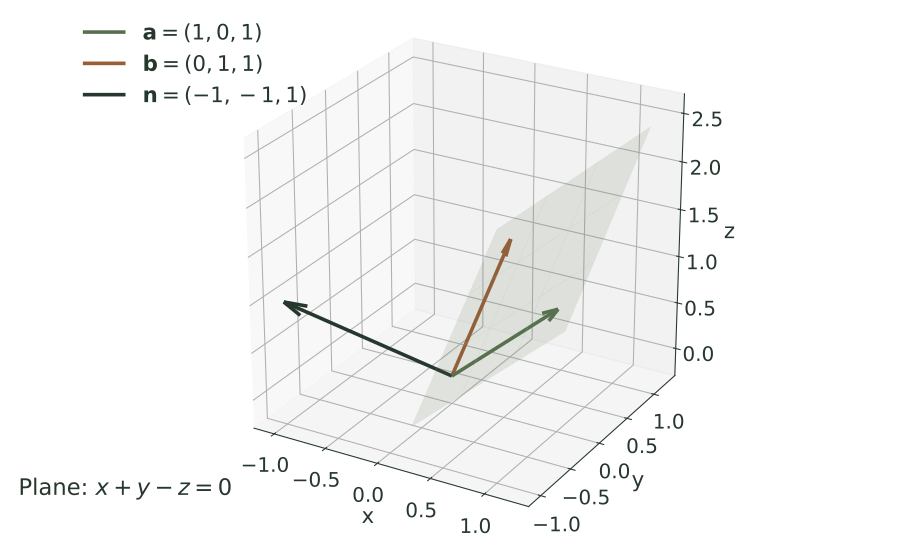 The calculation, not the perspective drawing alone, establishes perpendicularity. Open full-size figure ↗
- Calculate a⋅n and b⋅n.
- What does this tell you about n?
- Does 2n give another normal direction?
Compare your reasoning
Both scalar products are zero.
n is perpendicular to each of the two non-parallel vectors, so it is normal to their plane.
Yes. Any nonzero scalar multiple is also normal to that plane.
Magnitude and direction
For a nonzero vector, divide by its magnitude to get a unit vector in the same direction.
∣a∣=a12+a22+a32,a=∣a∣a Scalar product and projection
The scalar product is a number. For nonzero b, the vector projection of a onto b is:
projba=∣b∣2a⋅bb Vector product and a plane
For non-parallel vectors, a×b is a nonzero vector perpendicular to both. A plane through r0 with normal n=0 satisfies:
n⋅(r−r0)=0 03 · 15 minutes · Explain each step
Work it through
Worked example 1
An angle and a projection
Let a=(3,1) and b=(1,2). Find the angle between them and the projection of a onto b.
- a⋅b=3+2=5, ∣a∣=10 and ∣b∣=5.
- cosθ=1055=21, so θ=π/4.
- projba=55(1,2)=(1,2).
- The remainder (3,1)−(1,2)=(2,−1) is perpendicular to b: its dot product is 0.
Worked example 2
Build a plane from two directions
Find the plane through the origin containing a=(1,0,1) and b=(0,1,1).
- Use a×b=(a2b3−a3b2, a3b1−a1b3, a1b2−a2b1).
- Here a×b=(−1,−1,1). Check its scalar product with each direction is zero.
- The plane is −x−y+z=0, equivalently x+y−z=0.
- A reversed vector product gives the opposite normal, but the same plane.
04 · 20 minutes · Work by hand, then check
Try it yourself
Start with questions 1–4. Continue to 5–6 if time allows, or finish them after class. Show your reasoning before opening an answer.
Find the magnitude of a=(2,−1,2) and a unit vector in its direction.
Show worked answer
∣a∣=3; a=(32,−31,32).
The squared magnitude is 4+1+4=9.
Calculate (1,2,−1)⋅(3,0,4).
Show worked answer
−1
3+0−4=−1.
Find k so that (1,k,2) is perpendicular to (2,1,−1).
Show worked answer
k=0
Set the scalar product to zero: 2+k−2=0.
Calculate (1,0,0)×(0,1,0).
Show worked answer
(0,0,1)
Use the component formula or the right-hand orientation of the coordinate axes.
Find a plane through (1,0,2) with normal (2,−1,1).
Show worked answer
2x−y+z=4
2(x−1)−y+(z−2)=0.
Find where the line r=(1,0,1)+t(1,1,0) meets x+y−z=0.
Show worked answer
t=0, at (1,0,1).
Substitute x=1+t, y=t, z=1: 2t=0.
Quick checks
Choose an answer, then check your reasoning.
05 · 5 minutes · An independent check
Exit ticket
Close your notes and try both questions. Then write one idea you can explain and one question you still have.
How does b×a compare with a×b?
Show worked answer
b×a=−(a×b)
Reversing the order reverses the direction.
Verify that the projection remainder (2,−1) is perpendicular to (1,2).
Show worked answer
(2,−1)⋅(1,2)=2−2=0.
Both vectors are nonzero, so the zero scalar product gives perpendicularity.
Keep the idea working
After class
Finish any remaining practice, then try these two follow-up questions.
Find a plane through (0,1,2) with normal (1,2,−1).
Show worked answer
x+2y−z=0
x+2(y−1)−(z−2)=0.
Find the projection of (2,3) onto (1,0).
Show worked answer
(2,0)
The projection coefficient is 2/1=2.
Mark complete when you have attempted the practice and checked your exit ticket.