Analyse a simple rational function using its domain and derivative.
Differentiate an equation implicitly.
Use a derivative to justify a tangent or a turning point.
Skills to bring
Methods differentiation rules
Rational functions and asymptotes
The chain rule
01 · 8 minutes · Start without a calculator
Warm up
Try these in your notebook. Use the answers to spot anything to revisit.
Differentiate x3.
Show worked answer
3x2
Use the power rule.
Differentiate x1 for x=0.
Show worked answer
−x21
Write it as x−1 and apply the power rule.
Differentiate (x2+1)2.
Show worked answer
4x(x2+1)
The chain rule gives 2(x2+1)⋅2x.
02 · 12 minutes · Think, then discuss
A rule with two branches
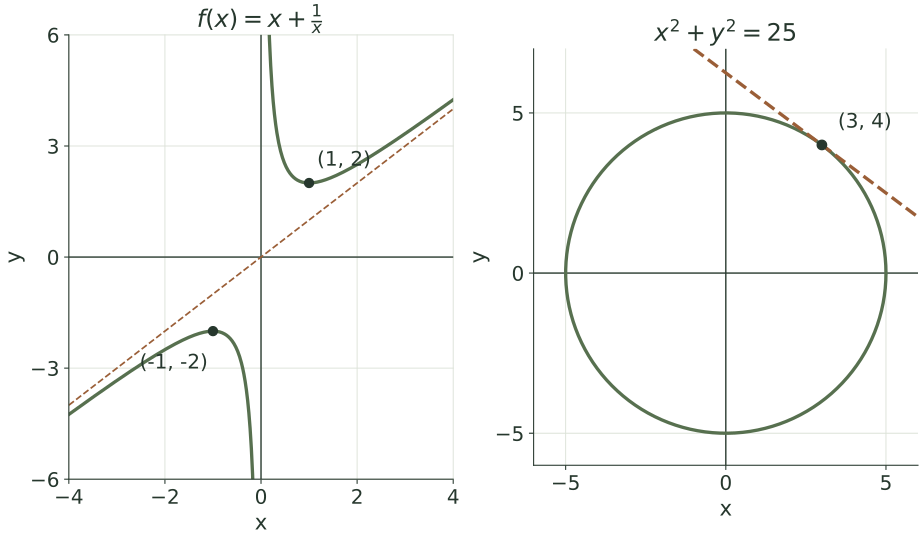
Consider f(x)=x+x1. Use its rule, a few exact values and the graph to make predictions.
Use the rational curve on the left for the exploration. The circle on the right is used in worked example 2. Open full-size figure ↗
Why is x=0 excluded?
Compare f(1/2), f(1) and f(2). What might happen at x=1?
What does f(x)−x=1/x suggest when ∣x∣ becomes large?
Compare your reasoning
The denominator is zero there, so the function has no point with input 0.
The outputs are 5/2, 2 and 5/2. This suggests a local minimum at (1,2); the derivative will justify it.
The difference tends to zero, so the oblique asymptote is y=x.
Domain first
A derivative calculation cannot create points where the original function is undefined. Keep the domain visible throughout.
Stationary does not automatically mean turning
Solve f′(x)=0, then check the sign on either side. A change from positive to negative gives a local maximum; negative to positive gives a local minimum.
Implicit differentiation
When y depends on x, differentiating y2 uses the chain rule.
dxd(y2)=2ydxdy
03 · 15 minutes · Explain each step
Work it through
Worked example 1
Justify the turning points
Find and classify the stationary points of f(x)=x+x1, for x=0.
f′(x)=1−x21=x2x2−1.
The stationary inputs are x=−1 and x=1, giving points (−1,−2) and (1,2).
The derivative is positive for x<−1 and x>1; negative for −1<x<0 and 0<x<1.
Thus (−1,−2) is a local maximum and (1,2) is a local minimum. No point exists at x=0.
Worked example 2
A tangent without solving for y
Find the tangent to x2+y2=25 at (3,4).
Differentiate with respect to x: 2x+2ydxdy=0.
Where y=0, dxdy=−yx. At (3,4) the gradient is −3/4.
The tangent is y−4=−43(x−3).
Check that (3,4) lies on the circle: 9+16=25.
04 · 20 minutes · Work by hand, then check
Try it yourself
Start with questions 1–4. Continue to 5–6 if time allows, or finish them after class. Show your reasoning before opening an answer.
Rewrite x−1x+2 to identify its domain and asymptotes.
Show worked answer
1+x−13; x=1; asymptotes x=1 and y=1.
Write the numerator as (x−1)+3.
Find the stationary points of g(x)=x+x4.
Show worked answer
(−2,−4) and (2,4)
g′(x)=1−4/x2=0 gives x=±2; substitute into g.
Find the tangent to x2+2y2=18 at (4,1).
Show worked answer
y−1=−2(x−4)
2x+4ydxdy=0 gives slope −x/(2y)=−2 at (4,1).
Find the gradient of y2=x at (4,2).
Show worked answer
41
2ydxdy=1, so the gradient is 1/(2y)=1/4.
For f(x)=x+x1, f′′(x)=x32 changes sign across 0. Is there an inflection point at 0?
Show worked answer
No. The function is undefined at 0.
There is no point on the curve at that input, so a sign change across the gap is not an inflection point.
Given g′(x)=2x+1 and g(0)=3, find g(x).
Show worked answer
g(x)=x2+x+3
An antiderivative is x2+x+C. The initial value gives C=3.
Quick checks
Choose an answer, then check your reasoning.
05 · 5 minutes · An independent check
Exit ticket
Close your notes and try both questions. Then write one idea you can explain and one question you still have.
Find the tangent gradient to x2+y2=25 at (0,5).
Show worked answer
0
−x/y=0/5=0; the tangent is horizontal.
Give an example showing that a stationary point need not be a local maximum or minimum.
Show worked answer
y=x3 at (0,0).
The derivative 3x2 is zero at 0 but positive on both sides.
Keep the idea working
After class
Finish any remaining practice, then try these two follow-up questions.
Find the tangent to x2+y2=25 at (4,3).
Show worked answer
y−3=−34(x−4)
The gradient is −x/y=−4/3.
Find the stationary points of x+x9.
Show worked answer
(−3,−6) and (3,6)
1−9/x2=0 gives x=±3; substitute into the original rule.
Mark complete when you have attempted the practice and checked your exit ticket.