ATAR Master · Year 12 Specialist Headstart
Calculus: connect the representations
Student questions · 60-minute lesson
Name: ____________________________ Date: ______________
Warm-up
Start without a calculator.
Differentiate .
Differentiate for .
Differentiate .
Explore
Consider . Use its rule, a few exact values and the graph to make predictions.
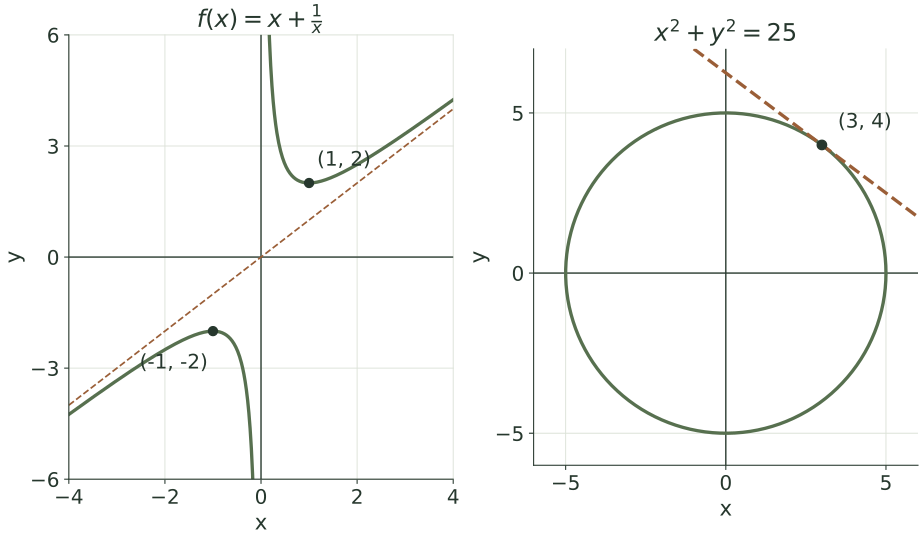
Why is excluded?
Compare , and . What might happen at ?
What does suggest when becomes large?
Practice
Show your working; use extra paper for extended proofs. Questions 1–4 are the core; finish 5–6 after class if needed.
Rewrite to identify its domain and asymptotes.
Find the stationary points of .
Find the tangent to at .
Find the gradient of at .
For , changes sign across 0. Is there an inflection point at 0?
Given and , find .
Exit ticket
Try these independently with your notes closed.
Find the tangent gradient to at .
Give an example showing that a stationary point need not be a local maximum or minimum.
After class
Follow-up questions.
Find the tangent to at .
Find the stationary points of .