Year 12 Specialist · Lesson 02 of 04 · 60 minutes
Complex numbers: powers and roots
How do distance and angle make complex-number calculations visible?
By the end, you can…
- Move between Cartesian and polar forms.
- Use multiplication to interpret powers geometrically.
- Find and represent all roots of a simple complex equation.
Skills to bring
- Complex arithmetic and conjugates
- Radians and exact trigonometric values
- The unit circle
01 · 8 minutes · Start without a calculator
Warm up
Try these in your notebook. Use the answers to spot anything to revisit.
Calculate i2 and i4.
Show worked answer
−1 and 1
i4=(i2)2=1.
Find the modulus of 3+4i.
Show worked answer
5
32+42=5.
Give sin(π/6) and cos(π/6).
Show worked answer
21 and 23
Use the first-quadrant exact values.
02 · 12 minutes · Think, then discuss
Multiplication turns and stretches
Plot 1, i, −1 and −i on an Argand diagram. Multiply each by i and describe the movement.
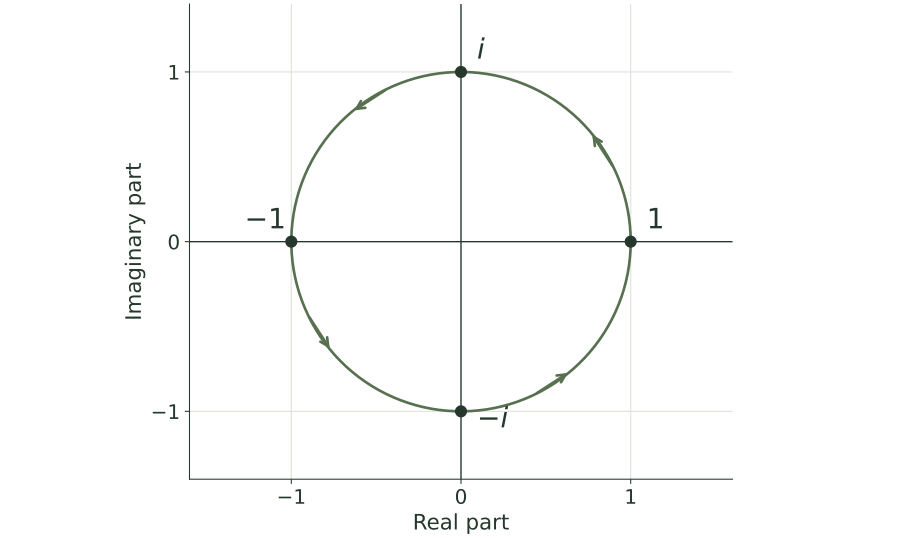 Multiplication by i adds a quarter turn and leaves the modulus unchanged. Open full-size figure ↗
- 1→i→−1→−i→1
- What happens to the modulus at each step?
- Predict the effect of multiplication by 2i.
Compare your reasoning
Each multiplication by i rotates the point anticlockwise through a right angle.
All four points have modulus 1.
Multiplication by 2i doubles the modulus and adds π/2 to the argument.
Two descriptions
For z=a+bi=0, the modulus is r=a2+b2. Choose the angle from the correct quadrant.
z=rcisθ=r(cosθ+isinθ) Powers
For a nonzero complex number and integer n, raise the modulus to the power and multiply the angle by n.
(rcisθ)n=rncis(nθ) Roots
For zn=rcisθ with r>0 and positive integer n, use k=0,…,n−1.
zk=r1/ncis(nθ+2kπ) 03 · 15 minutes · Explain each step
Work it through
Worked example 1
See a square in two ways
Calculate (1+i)2 using Cartesian and polar forms.
- Cartesian: (1+i)2=1+2i+i2=2i.
- Polar: 1+i=2cis(π/4).
- Squaring gives 2cis(π/2)=2i. The modulus is squared and the angle is doubled.
Worked example 2
Find every cube root
Solve z3=8 and show the roots on an Argand diagram.
- Write 8=8cis(2kπ).
- The roots have modulus 2 and arguments 0, 2π/3 and 4π/3.
- Thus z=2, z=−1+3i or z=−1−3i.
- The three points are equally spaced on a circle of radius 2. Each cubes to 8.
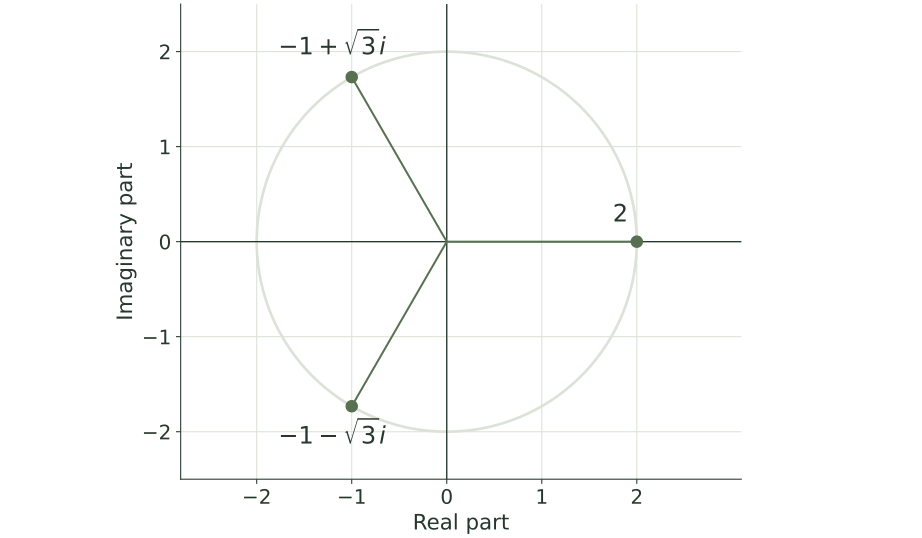 For z3=8, the three roots have modulus 2 and equal angle gaps of 2π/3.
04 · 20 minutes · Work by hand, then check
Try it yourself
Start with questions 1–4. Continue to 5–6 if time allows, or finish them after class. Show your reasoning before opening an answer.
Find the modulus and principal argument of −3+i. Use −π<Argz≤π.
Show worked answer
Modulus 2; principal argument 5π/6.
The point is in quadrant II, not quadrant IV.
Calculate (1+i)4.
Show worked answer
−4
(1+i)2=2i, so (1+i)4=(2i)2=−4.
Solve z2=−9.
Show worked answer
z=3i or z=−3i
Both values square to −9.
Find all fourth roots of 1.
Show worked answer
1, i, −1, −i
The arguments are 0, π/2, π and 3π/2, all with modulus 1.
Solve z2−2z+5=0.
Show worked answer
z=1±2i
Complete the square: (z−1)2=−4.
Find all solutions of z3=−8.
Show worked answer
−2, 1+3i, 1−3i
Write −8=8cis(π+2kπ).
Use arguments π/3, π and 5π/3, with modulus 2.
Quick checks
Choose an answer, then check your reasoning.
05 · 5 minutes · An independent check
Exit ticket
Close your notes and try both questions. Then write one idea you can explain and one question you still have.
Find the principal argument of −1−i in (−π,π].
Show worked answer
−3π/4
The point lies in quadrant III; use the representative in the specified interval.
Why is z=2 not the full solution of z3=8?
Show worked answer
There are also the two non-real roots −1±3i.
The root angles differ by 2π/3.
Keep the idea working
After class
Finish any remaining practice, then try these two follow-up questions.
Write 1−3i in polar form with principal argument.
Show worked answer
2cis(−π/3)
The modulus is 2 and the point is in quadrant IV.
Solve z2=4i.
Show worked answer
z=2+2i or z=−2−2i
Use modulus 2 and arguments π/4 and 5π/4.
Mark complete when you have attempted the practice and checked your exit ticket.