Worked example 1
A direct proof
Prove that the square of an odd integer is odd.
- Let , where .
- .
- Because is an integer, this has the form of an odd integer. Therefore is odd.
Year 12 Specialist · Lesson 01 of 04 · 60 minutes
What makes an argument work for every case?
01 · 8 minutes · Start without a calculator
Try these in your notebook. Use the answers to spot anything to revisit.
Is every prime number odd?
No: 2 is prime and even.
One counterexample disproves a universal claim.
Write a general odd integer using an integer .
, where .
The parameter must be an integer.
Calculate .
This is evidence for a pattern, not a proof for every number of terms.
02 · 12 minutes · Think, then discuss
The square grows by adding an L-shaped layer of odd size. Describe the pattern before looking at a symbolic proof.
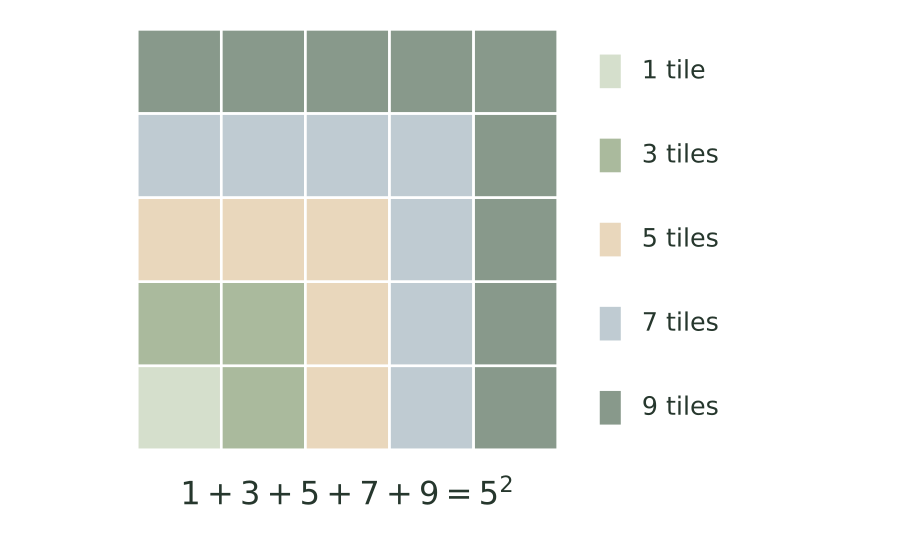
Add tiles: .
The conjecture is .
A finite list of examples cannot establish every case. Induction explains why the pattern continues.
To prove a claim for every allowed input, start with an arbitrary input and give a valid argument. One counterexample is enough to disprove it.
Writing an even integer as or an odd integer as makes the structure available for algebra.
For positive integers, prove the case . Assume the statement for an arbitrary , then use that assumption to prove it for .
03 · 15 minutes · Explain each step
Worked example 1
Prove that the square of an odd integer is odd.
Worked example 2
Prove for all positive integers .
04 · 20 minutes · Work by hand, then check
Start with questions 1–4. Continue to 5–6 if time allows, or finish them after class. Show your reasoning before opening an answer.
Write the contrapositive of: if , then is even, for integer .
If is not even, then .
The contrapositive of “if P then Q” is “if not Q then not P”.
Disprove: for every positive integer .
is a counterexample.
, so the strict inequality fails.
Prove that the product of two consecutive integers is even.
One of the two consecutive integers is even, so their product is even.
If is even, has an even factor. If is odd, is even. These cases cover every integer.
Prove that the square of an even integer is divisible by 4.
Let . Then , with .
This is a multiple of 4 by definition.
Prove by induction that for every positive integer .
The formula holds for every positive integer.
Base : . Assume the formula for .
Add : .
This is the required formula for , so induction completes the proof.
Prove by induction that for every positive integer .
is divisible by 3.
Base : . Assume for some integer .
.
The next case is a multiple of 3, completing the induction step.
Choose an answer, then check your reasoning.
05 · 5 minutes · An independent check
Close your notes and try both questions. Then write one idea you can explain and one question you still have.
Negate the statement: every integer has property P.
There exists an integer that does not have property P.
The negation is not “every integer lacks property P”.
Why does an induction proof need a base case?
The base case establishes a starting true statement.
The induction step only passes truth from one case to the next; it does not supply the starting case.
Keep the idea working
Finish any remaining practice, then try these two follow-up questions.
Prove that the sum of two odd integers is even.
for integers .
The result is twice an integer.
Use induction to prove for positive integers .
The base case and induction step establish the identity.
Base: . Assume the formula for .
Add : .
Mark complete when you have attempted the practice and checked your exit ticket.