ATAR Master · Year 12 Specialist Headstart
Vectors in three dimensions
Student questions · 60-minute lesson
Name: ____________________________ Date: ______________
Warm-up
Start without a calculator.
Find .
Calculate .
Calculate . What does this tell you?
Explore
Let , and . Use calculations and the diagram together.
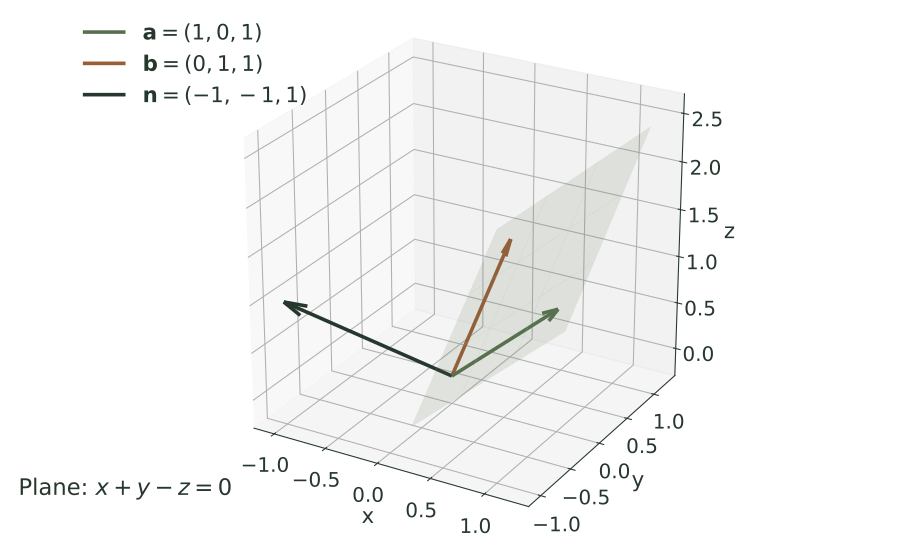
Calculate and .
What does this tell you about ?
Does give another normal direction?
Practice
Show your working; use extra paper for extended proofs. Questions 1–4 are the core; finish 5–6 after class if needed.
Find the magnitude of and a unit vector in its direction.
Calculate .
Find so that is perpendicular to .
Calculate .
Find a plane through with normal .
Find where the line meets .
Exit ticket
Try these independently with your notes closed.
How does compare with ?
Verify that the projection remainder is perpendicular to .
After class
Follow-up questions.
Find a plane through with normal .
Find the projection of onto .