By the end, you can…
- Connect expanded, factorised and vertex forms.
- Find intercepts, a vertex and a range.
- Sketch a quadratic using features rather than a table alone.
Skills to bring
- Expansion and factorisation
- Function notation
- Coordinates
01 · 8 minutes · Start without a calculator
Warm up
Try these in your notebook. Use the answers to spot anything to revisit.
Expand (x−2)2.
Show worked answer
x2−4x+4
Square the whole binomial.
Solve (x−1)(x−3)=0.
Show worked answer
x=1 or x=3
Use the null factor law.
Find the y-intercept of y=x2−4x+3.
Show worked answer
(0,3)
Set x=0.
02 · 12 minutes · Think, then discuss
Match the three descriptions
Compare the three rules below. Show algebraically that they define the same function, then decide which reveals each feature most directly.
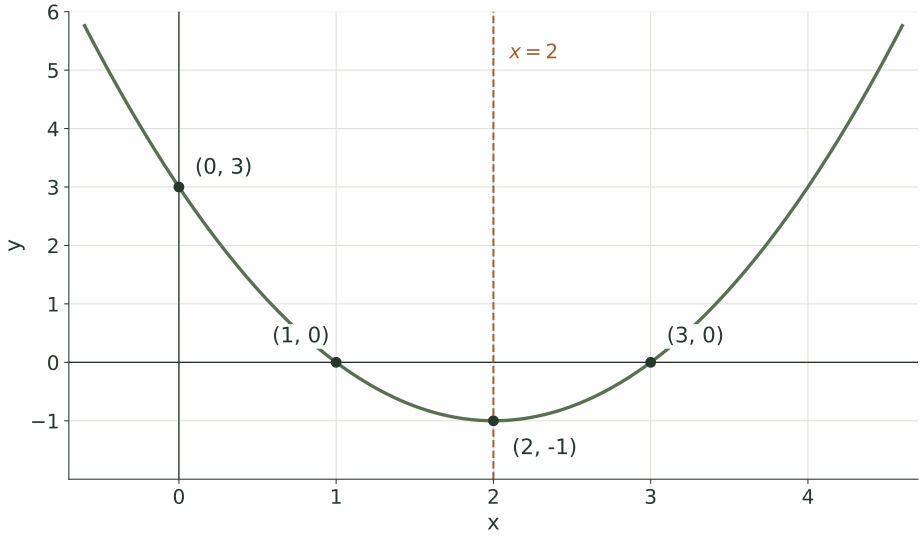 Three algebraic forms explain different features of this same graph. Open full-size figure ↗
- x2−4x+3
- (x−1)(x−3)
- (x−2)2−1
Compare your reasoning
Expanded form gives the y-intercept (0,3).
Factorised form gives x-intercepts (1,0) and (3,0).
Vertex form gives vertex (2,−1), axis x=2 and range [−1,∞).
Three forms, one function
Choose a representation that exposes the feature being asked for.
ax2+bx+ca(x−r1)(x−r2)a(x−h)2+k Vertex form
In a(x−h)2+k, the vertex is (h,k). The sign of a determines whether it is a minimum or a maximum.
Completing the square
Add and subtract the same quantity so the value is preserved.
x2+bx=(x+2b)2−4b2 03 · 15 minutes · Explain each step
Work it through
Worked example 1
Read a graph from its structure
Describe f(x)=x2−4x+3 for all real x.
- f(x)=(x−1)(x−3)=(x−2)2−1.
- The graph opens upwards; its vertex is (2,−1) and axis is x=2.
- The intercepts are (1,0), (3,0) and (0,3). The range is [−1,∞).
Worked example 2
Keep the scale factor outside
Write g(x)=2x2+8x+3 in vertex form.
- g(x)=2(x2+4x)+3.
- x2+4x=(x+2)2−4.
- g(x)=2(x+2)2−5. The vertex is (−2,−5).
04 · 20 minutes · Work by hand, then check
Try it yourself
Start with questions 1–4. Continue to 5–6 if time allows, or finish them after class. Show your reasoning before opening an answer.
Expand (x+3)2−4.
Show worked answer
x2+6x+5
Expand the square, then combine constants.
Factorise x2−6x+8 and find its zeros.
Show worked answer
(x−2)(x−4); zeros 2 and 4.
The factors have product 8 and sum −6.
Find the vertex and range of y=(x−3)2+2 on R.
Show worked answer
Vertex (3,2); range [2,∞).
The square is nonnegative.
Write x2+6x+5 in vertex form.
Show worked answer
(x+3)2−4
x2+6x+9−9+5=(x+3)2−4.
Find the vertex and zeros of y=−(x−1)2+4.
Show worked answer
Vertex (1,4); zeros −1 and 3.
For a zero, (x−1)2=4, so x−1=±2.
Find the range of f(x)=(x−2)2−1 on [0,3].
Show worked answer
[−1,3]
Check the vertex and both endpoints: −1, 3 and 0.
Quick checks
Choose an answer, then check your reasoning.
05 · 5 minutes · An independent check
Exit ticket
Close your notes and try both questions. Then write one idea you can explain and one question you still have.
Give the axis and minimum value of 2(x+1)2−3.
Show worked answer
Axis x=−1; minimum −3.
The square becomes zero at x=−1.
Why is (x−2)2 not equal to x2−4?
Show worked answer
The expansion contains a middle term: x2−4x+4.
A numerical counterexample is x=0: 4 is not −4.
Keep the idea working
After class
Finish any remaining practice, then try these two follow-up questions.
Find the vertex of x2−8x+11.
Show worked answer
(4,−5)
x2−8x+11=(x−4)2−5.
Solve (x+2)2=9.
Show worked answer
x=1 or x=−5
x+2=±3.
Mark complete when you have attempted the practice and checked your exit ticket.