Worked example 1
Locate the decision boundary
Compare and for .
- Solve to get .
- The common cost is dollars.
- Testing either side shows A is cheaper below 6 km and B is cheaper above 6 km.
Year 11 Methods · Lesson 04 of 04 · 60 minutes
How can a model help us make and justify a decision?
01 · 8 minutes · Start without a calculator
Try these in your notebook. Use the answers to spot anything to revisit.
Find the gradient through and .
.
Solve .
Subtract and 4 from both sides.
Find the maximum of .
, at .
The non-positive squared term is largest when it equals zero.
02 · 12 minutes · Think, then discuss
Two hypothetical transport services use the rules below, with distance in kilometres and cost in dollars. Choose a service for short and long trips, and justify where your decision changes.
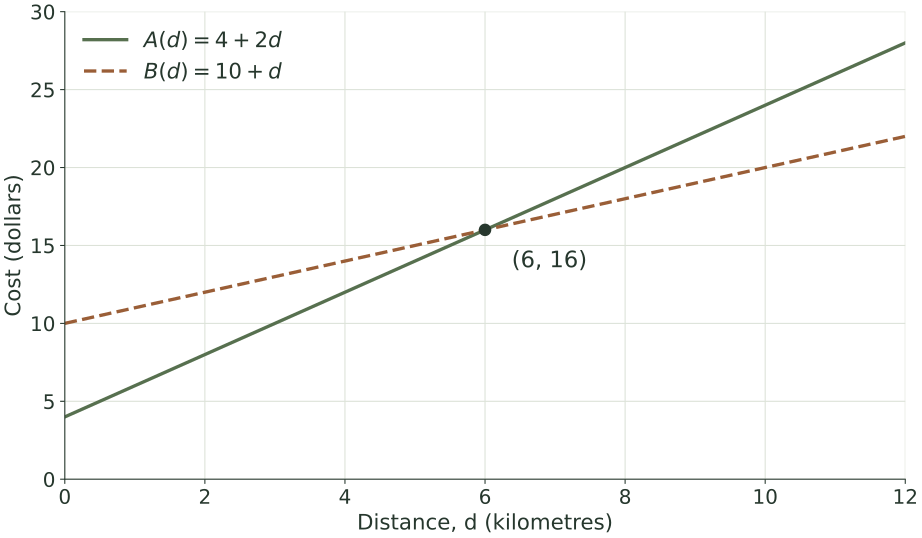
At 2 km: A costs 8 and B costs 12. At 6 km: both cost 16. At 10 km: A costs 24 and B costs 20.
A has the lower starting charge, but its cost increases faster.
For , A is cheaper when ; B is cheaper when .
State what each variable measures and which inputs are reasonable before solving.
A cost-versus-distance gradient is a cost per kilometre. An intercept describes the cost at zero distance.
Use the algebra and the graph together, then express the answer in the language of the situation.
03 · 15 minutes · Explain each step
Worked example 1
Compare and for .
Worked example 2
A wall forms one side of a rectangular garden. There are 20 m of fencing for the other three sides. Let each perpendicular side be metres. Find the greatest possible area.
04 · 20 minutes · Work by hand, then check
Start with questions 1–4. Continue to 5–6 if time allows, or finish them after class. Show your reasoning before opening an answer.
A hire cost is . Find and interpret it.
24 dollars for 4 hours.
.
Find when and give the same cost.
, common cost 45.
gives .
Find the linear rule through and .
The gradient is 3; use to get .
A tank has litres while draining. State the emptying time, domain and range.
25 min; domain ; range .
Solve and retain nonnegative time and volume.
For , find the average rate of change from to .
.
A wall forms one side of a rectangular garden. There are 16 m of fencing for the other three sides. Find the dimensions giving the greatest area.
Perpendicular sides 4 m, remaining side 8 m; area .
, with .
Choose an answer, then check your reasoning.
05 · 5 minutes · An independent check
Close your notes and try both questions. Then write one idea you can explain and one question you still have.
A delivery model is . Find the cost at 8 km.
18 dollars.
.
Find the intersection of and .
gives and common value 21.
Keep the idea working
Finish any remaining practice, then try these two follow-up questions.
A linear model passes through and . Find its rule.
The gradient is .
A three-sided garden uses 24 m of fencing. Find its maximum area.
, attained at .
Mark complete when you have attempted the practice and checked your exit ticket.