ATAR Master · Year 11 Methods Headstart
Models, graphs and decisions
Student questions · 60-minute lesson
Name: ____________________________ Date: ______________
Warm-up
Start without a calculator.
Find the gradient through and .
Solve .
Find the maximum of .
Explore
Two hypothetical transport services use the rules below, with distance in kilometres and cost in dollars. Choose a service for short and long trips, and justify where your decision changes.
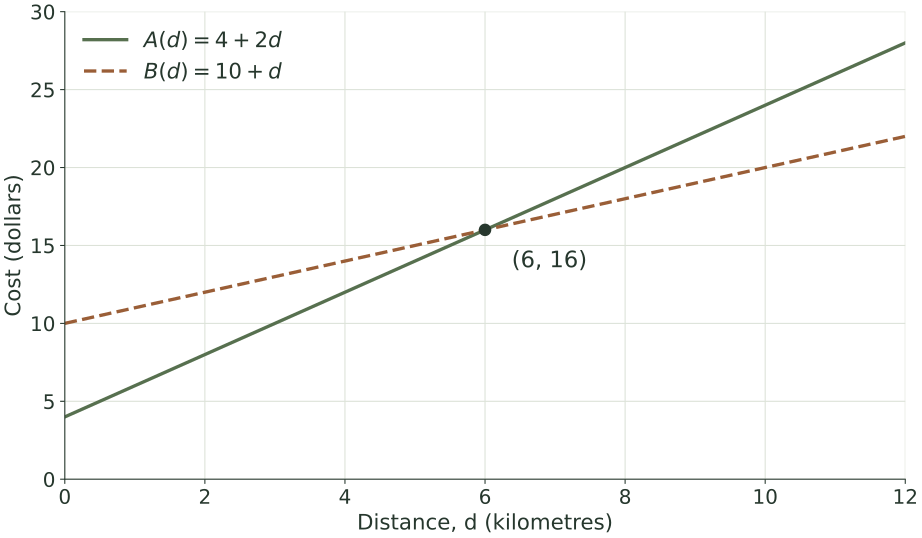
Compare a 2 km, 6 km and 10 km trip.
Practice
Show your working; use extra paper for extended proofs. Questions 1–4 are the core; finish 5–6 after class if needed.
A hire cost is . Find and interpret it.
Find when and give the same cost.
Find the linear rule through and .
A tank has litres while draining. State the emptying time, domain and range.
For , find the average rate of change from to .
A wall forms one side of a rectangular garden. There are 16 m of fencing for the other three sides. Find the dimensions giving the greatest area.
Exit ticket
Try these independently with your notes closed.
A delivery model is . Find the cost at 8 km.
Find the intersection of and .
After class
Follow-up questions.
A linear model passes through and . Find its rule.
A three-sided garden uses 24 m of fencing. Find its maximum area.