ATAR Master · Year 11 Methods Headstart
One quadratic, three useful forms
Student questions · 60-minute lesson
Name: ____________________________ Date: ______________
Warm-up
Start without a calculator.
Expand .
Solve .
Find the y-intercept of .
Explore
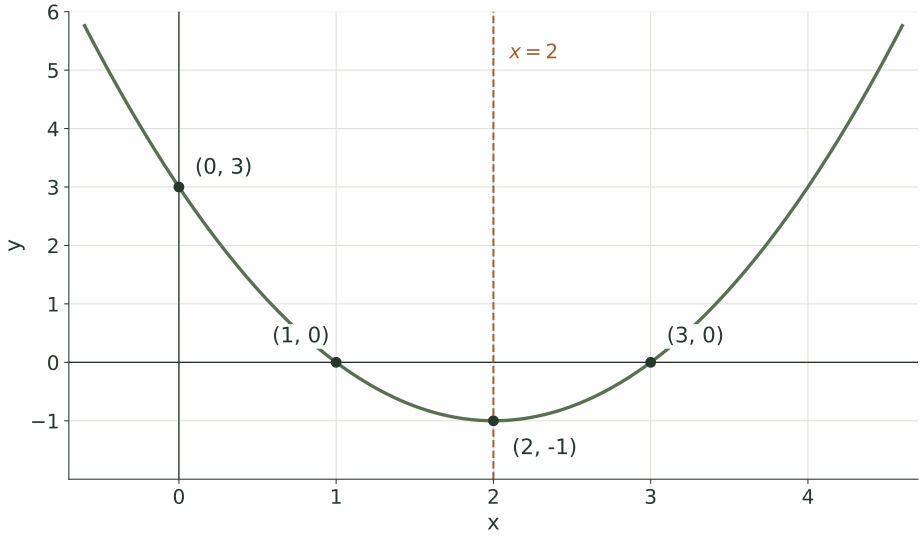
Compare the three rules below. Show algebraically that they define the same function, then decide which reveals each feature most directly.
Practice
Show your working; use extra paper for extended proofs. Questions 1–4 are the core; finish 5–6 after class if needed.
Expand .
Factorise and find its zeros.
Find the vertex and range of on .
Write in vertex form.
Find the vertex and zeros of .
Find the range of on .
Exit ticket
Try these independently with your notes closed.
Give the axis and minimum value of .
Why is not equal to ?
After class
Follow-up questions.
Find the vertex of .
Solve .