Some reactions finish in a flash (a campfire, a missile launch); others take years (milk spoiling, a ship rusting). Today we meet the model that explains why — collision theory — and the two requirements every successful collision must satisfy.
Learning Intentions + Success Criteria
LITo explain reaction rate using the two requirements of a successful collision.
SC: I can:
01I can state the two requirements for a successful collision (sufficient energy ≥ Ea AND correct orientation).
02I can define activation energy and explain why most collisions are unsuccessful.
03I can use collision theory to explain why some reactions are fast (e.g. wood burning) and others slow (e.g. iron rusting).
01
Engage
5 min
↺Quick recap · from last class
L13 · §4.4 Neutralisation and other reactions of acids — acid + metal carbonate / metal oxide
Try these 2questions before today's new content. Click an answer for instant feedback — your teacher will walk through them with you.
Wood burning is a fast chemical reaction that may be completed in a few hours. Iron rusting is a slow chemical reaction that can take many years. Both involve a substance reacting with oxygen. Why do you think one is so much faster than the other?
02
Explicit
17 min
Today's procedure — predicting if a collision yields a reaction
START — two reactant particles approach each other
↓
1. Do they actually collide?
most particles in a solution just miss each other
↓
2. Check requirement A: collision energy ≥ activation energy (Eₐ)?
↓
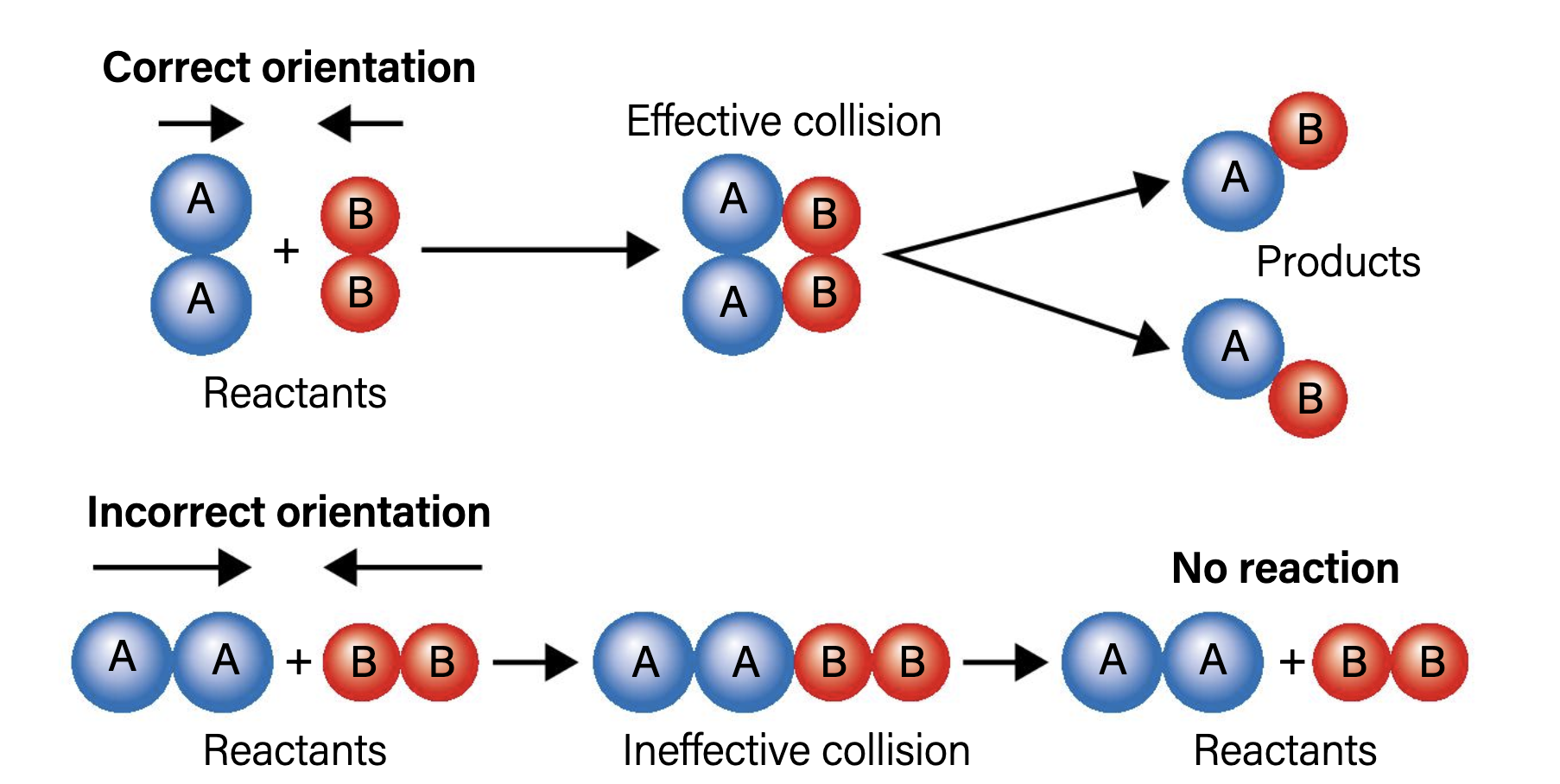
3. Check requirement B: is the orientation correct?
bonding sites must line up — see Figure 4.26 below
↓
4. Are BOTH requirements met?
↓
↓ No
Bounce off. No reaction — particles separate, reactants unchanged.
↓ Yes
REACTION! Bonds break, new bonds form, products are released.
Most collisions fail. The reaction rate is set by how often successful ones happen.
Rate of reaction
The rate of a chemical reaction is how quickly reactants are converted into products over a period of time. Reactions span a huge range:
Speed
Examples
Fast (seconds to hours)
campfire burning, missile launch, fireworks
Slow (days to years)
milk spoiling, a ship rusting, marble statues weathering
Same chemistry rules apply to both; the rate is set by how particles collide.
Collision theory — two requirements
Collision theory says a reaction only happens when reactant particles collide AND the collision is successful. There are two requirements (both must be met):
Sufficient energy. The collision must hit hard enough to break the reactant bonds. The minimum required is the activation energy (Eₐ) — picture it as an energy hill the particles must climb.
Correct orientation. The atoms must line up so the bonding sites face each other (see Figure 4.26 below).
If either requirement fails → particles bounce off, no reaction.
The reaction rate = collision frequency × fraction of those collisions that succeed.
Figure 4.26 — orientation matters
The same two reactants (A + B–C) can collide in two ways. Only one of them produces a reaction.
Figure 4.26 — Reacting particles must collide with the correct orientation. Both rows start from the same reactants (A-A + B-B); only the top alignment produces products. Source: Good Science VIC Year 10.
Many factors can affect reaction rate
The reaction rate is not fixed. Six factors can change it:
concentration
surface area
pressure
temperature
catalysts
agitation (stirring)
The next two lessons (L13, L14) explore the bold four — concentration, temperature, surface area and catalysts — in detail.
Key terms
Keywords
activation energy (Eₐ)
The energy required for successful collisions and a chemical reaction to occur.
collision theory
A theory which states that for a chemical reaction to occur, particles must collide with the correct orientation and with enough energy; can be used to predict the rate of reactions.
⚠Watch out · common traps
1
Trap 1
“Any collision between reactant particles leads to a reaction.”
Wrong — most collisions go nowhere. For a reaction to happen, both requirements must be met:
enough energy (≥ Eₐ), AND
the correct orientation.
Plenty of high-energy collisions still fail because the particles meet on the wrong side. Plenty of well-aligned collisions still fail because they're too slow to break bonds. Only the tiny fraction that satisfies both produces a reaction.
Rule: collision ≠ reaction. The rate is set by how often successful collisions happen, not how often particles hit each other.
2
Trap 2
“Higher temperature only matters because particles move faster.”
Incomplete — heating a reaction does two things at once:
Particles move faster ⇒ collision frequency rises (more collisions per second).
Each collision is more energetic ⇒ a bigger fraction of collisions clear Eₐ.
The textbook point is qualitative: at higher temperature, more collisions have enough energy to overcome the activation energy, so the reaction rate increases.
Rule: temperature changes both how often and how energetically particles collide — not just how often.
3
Trap 3
“Activation energy is the energy of the reaction.”
Wrong — Eₐ is the starting hump, not the overall energy change.
Eₐ = the minimum energy a collision must carry to start the reaction.
The overall energy change of the reaction (negative for exothermic, positive for endothermic) is something different — it depends on the energy difference between reactants and products. You'll meet this in §4.7 (Matter and energy).
Two reactions can share the same Eₐ but have very different overall energy changes (one releases heat, the other absorbs it).
Rule: Eₐ = climb the hill; overall energy change = where you end up.
03
Apply
25 min
Question 1The two requirements
Fill in the blanks to complete the collision-theory rule:
Question 2Will the collision succeed?Question 3Compare two reactions
▸Your turnShort answer · Have a go first
Wood burning is fast (a few hours); iron rusting is slow (many years). Both involve a substance reacting with oxygen. Use collision theory to give one reason why wood burning is faster.
Question 4Match the term to its meaning
04
Catch
5 min05
Reflect
10 min
▸Your turnReflect · One thing you learned
One thing I now understand about why some reactions are fast and others slow that I didn't understand at the start of the lesson:
Success criteria — where are you right now?
Next class (Fri 15 May, P2): §4.5 application and consolidation — work through the textbook Learning Ladder questions.