§4.3you are here
Single displacement (Zn + Cu²⁺)
last week · Wed P5
Zn(s) + CuSO₄(aq) → ZnSO₄(aq) + Cu(s)
DriverZn kicks Cu²⁺ out of solution.
What you seeBlue solution fades; brown Cu coats the Zn strip.
LITo describe the features of single-displacement reactions and use the activity series of metals to predict whether one will occur.
SC: I can:
Try these 2questions before today's new content. Click an answer for instant feedback — your teacher will walk through them with you.
Watch this short introduction to displacement reactions — the pattern where one element "kicks out" another from a compound. Then make your prediction below before we go deeper into the activity series.
The video introduces displacement — one metal pushing another out of a compound. Predict: a strip of zinc metal is left sitting in a beaker of blue copper(II) sulfate solution for an hour. What changes would you expect to see (a) on the surface of the zinc, and (b) in the colour of the solution? Justify in one sentence using the idea from the video.
In some reactions, an element displaces another element in a compound. A single element might replace another element, or two elements of two different compounds may replace each other.
A displacement reaction occurs when an element replaces another element in a compound. When one element displaces another element in a compound, it is called a single-displacement reaction. This typically happens when a more reactive element replaces a less reactive one in a compound.
General form (Figure 4.7):
Figure 4.7 — A more reactive atom A kicks B out of the B–C compound and bonds with C in B's place.
Element A is more reactive than element B, so A forms a chemical bond with C, causing B to be displaced from the compound.
Single-displacement reactions often occur between metals and ionic salts. (An ionic salt is a compound made up of a cation — a positive ion — and an anion — a negative ion.)
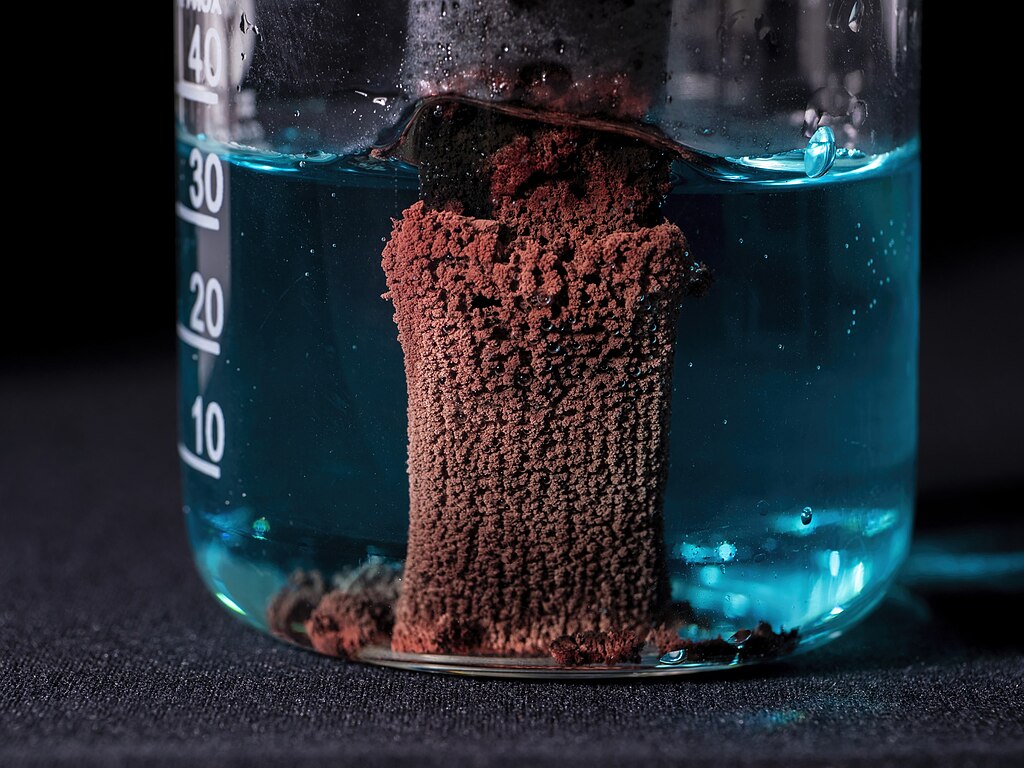
For example, when a piece of zinc metal is placed in copper(II) sulfate solution, zinc displaces copper to form zinc sulfate and solid copper.
In this case, zinc is more reactive than copper and, therefore, displaces it from the ionic solution.
Zoom in on the same reaction at the particle level. CuSO₄ is an ionic salt (textbook key term: a compound made up of a cation and an anion), held together by two charged species:
When the zinc strip drops in, what really happens is a cation swap:
That's why we call this a displacement reaction: zinc displaces copper from the cation slot of the ionic salt. The anion is a passenger, the cation is what actually swaps. (Word "ion" is the umbrella term — any atom that has lost or gained electrons to become charged. Cu²⁺, Zn²⁺ and SO₄²⁻ are all ions; positive ones are cations, negative ones are anions.)
Figure 4.8 — Zinc is more reactive than copper, so when zinc metal is placed in a solution of copper(II) sulfate, the zinc replaces the copper in solution and solid copper forms.
Source — Wikimedia Commons (CC BY-SA 4.0)
To determine whether a displacement reaction will occur, we can use the activity series of metals. If pure, solid metal is more reactive than the metal cation in solution, then a reaction will occur. For example, zinc is above copper on the activity series, indicating that it will displace copper from its compound, forming solid copper.
Increasing
activity
This is a simplified activity series of metals (textbook Figure 4.9). It can be used to determine if a displacement reaction will occur when a metal is combined with an ionic compound in solution.
Note: you'll sometimes see this series ordered slightly differently in other resources — for example with K above Li instead of Li at the top. That's because there are two valid criteria for ranking metal reactivity: the thermodynamic ordering (based on standard electrode potentials, where Li sits at the top) and the kinetic / observational ordering (based on how vigorously the metals actually react in a beaker, where K can sit above Li because Li reacts more slowly than its thermodynamic position predicts). For VCE Year 10 we use the textbook Figure 4.9 ordering above.
Now try the rule interactively. Drop a metal into a metal-salt solution and see whether the sim shows a reaction:
Double-displacement reactions are Friday's L4 — today's focus stays on single displacement and the activity series.
Work through all three questions.
Magnesium metal is dropped into a solution of zinc nitrate. Magnesium is above zinc in the activity series, so a displacement reaction occurs.
The symbol equation:
(Magnesium is above zinc in Figure 4.9, so magnesium displaces zinc.)
One thing I now understand about single displacement or the activity series that I didn't understand before:
Next class (Fri 1 May, P2): double displacement and precipitation. You'll meet Table 4.2 — the solubility rules — and predict which precipitates fall out when two solutions are mixed.