Synthesis and decomposition — decomposition deep-dive and balancing
Today we zoom in on ONE of last lesson's patterns — decomposition — using the textbook's lead example: hydrogen peroxide breaking down into water and oxygen. You'll learn the single skill every chemist needs next: balancing a chemical equation so the atoms on the left match the atoms on the right.
Learning Intentions + Success Criteria
LITo interpret and balance chemical equations for decomposition reactions, using virtual-prac observations as evidence.
SC: I can:
01Identify a decomposition reaction from observation evidence (gas released, colour change, solid residue).
02Balance a simple chemical equation by counting atoms on each side.
03Predict the products of a metal carbonate decomposition.
04Explain why chemists balance equations — conservation of mass / atoms.
05Read and use the state symbols (s), (l), (g), (aq).
01
Engage
15 min
↺Quick recap · from last class
L4 · §4.2 Synthesis and decomposition — key features and word equations
Try these 3questions before today's new content. Click an answer for instant feedback — your teacher will walk through them with you.
Last lesson you met three kinds of decomposition — thermal, electrical, photochemical. Today we go deeper using the textbook's lead example: the decomposition of hydrogen peroxide (H₂O₂).
YouTube · Hydrogen peroxide decomposing (FuseSchool) · open in new tab
▸Predict · your turn
Write before you watch
Hydrogen peroxide on a shelf decomposes very slowly — that's why old bottles lose strength over months. Now a chunk of fresh liver (which contains the enzyme catalase) is dropped into a fresh beaker of H₂O₂. Predict: WHAT'S DIFFERENT about this reaction compared to the slow shelf decomposition? Be specific — speed? vigour? what you'd actually see? does the liver itself get used up?
Once you've written your three predictions, watch the real-world demo — fresh liver dropped straight into hydrogen peroxide. Compare what you see against what you predicted before going into Explicit.
YouTube · Liver + hydrogen peroxide — real demo (The Elkchemist) · open in new tab
And here's the same reaction with potato instead of liver. Both work because both tissues contain the enzyme catalase — a protein found in nearly all living cells (animal and plant), where its everyday job is to break down stray H₂O₂ that builds up during cellular respiration. The chemistry is identical: catalase from any source speeds the same H₂O₂ → H₂O + O₂ reaction.
Quick guess — if the potato had been cooked first (boiled, baked, or fried), would you still see vigorous foaming when it hits the H₂O₂? Decide yes / no / less in your head before revealing.
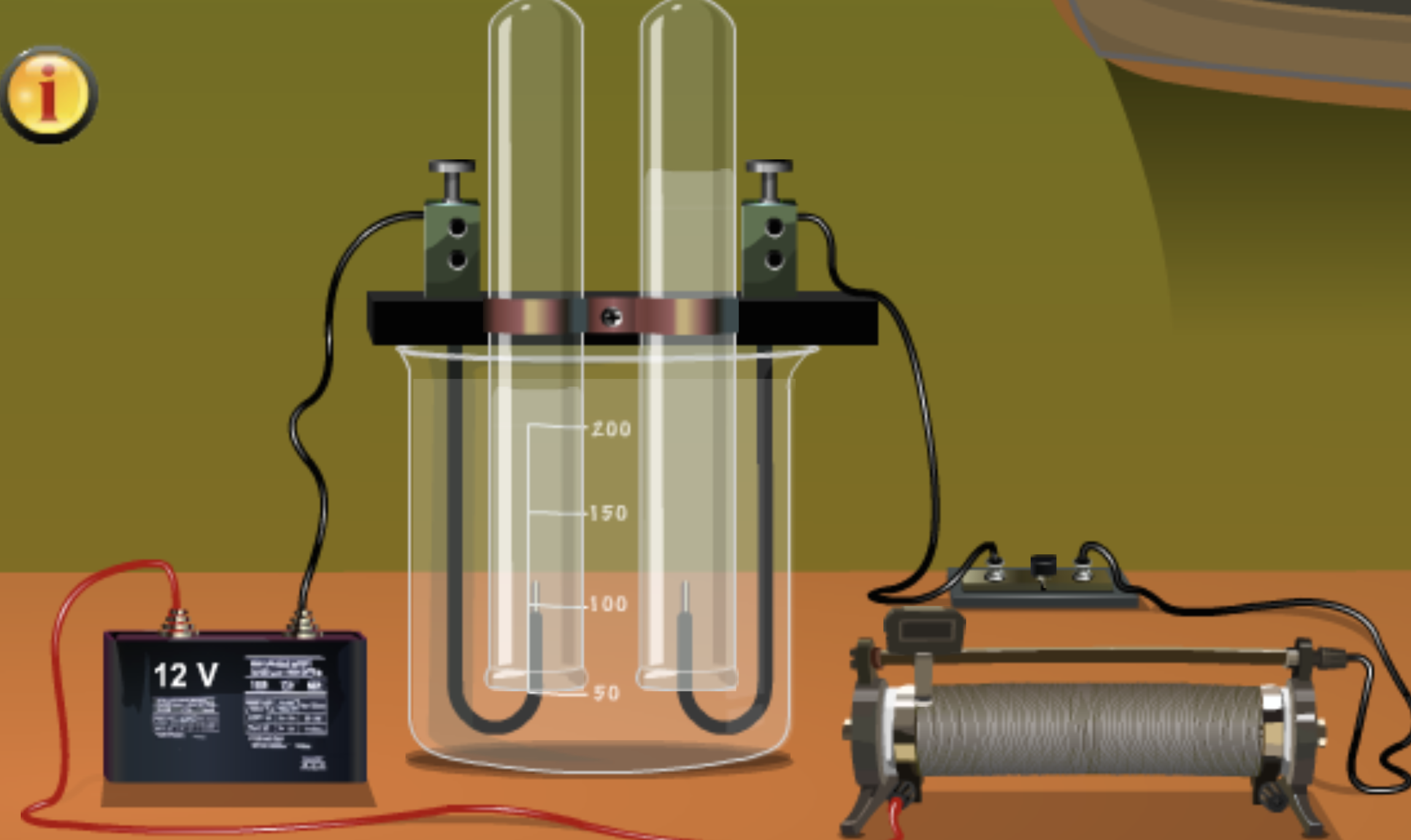
Now to a very different kind of decomposition — driven not by an enzyme, but by electricity. Open the OLabs simulation below on your laptop, choose Electrolytic Decomposition from the dropdown and Water as the sample, then switch on the 12 V battery. Watch the two test tubes for about thirty seconds.
Snapshot of the OLabs electrolysis-of-water sim after about 30 seconds. The two inverted tubes sit over the two electrodes; the left tube has clearly collected more gas (lower water level) than the right.
Source — amrita.olabs.edu.in
If your laptop won't run the sim, use the snapshot above as your observation. Otherwise compare what you actually saw to the options below:
Now look at the balanced equation for the electrolysis of water:
2H2O(l)electricity▶2H2(g)+O2(g)
The equation says: every 2 molecules of H₂ produced come paired with only 1 molecule of O₂ — a 2 : 1 ratio of molecules. You just observed a 2 : 1 ratio of gas volumes. Use the equation to figure out which gas is in which tube:
You just used the coefficients in a balanced equation to predict an experimental observation — that's the power of balancing equations. In Explicit, you'll learn how to write a balanced equation yourself when the coefficients aren't already given to you.
02
Explicit
15 min
What actually happens in the beaker
When liver (which contains the enzyme catalase) drops into a hydrogen peroxide solution, three pieces of evidence tell us a chemical reaction occurred:
Gas released — vigorous bubbling at the surface of the liver; the bubbles are pure oxygen (you can test by relighting a glowing splint).
Heat released — the beaker warms up; the reaction is exothermic.
Liquid left behind — as the H₂O₂ is used up, the solution becomes plain water.
2H2O2(aq)catalase▶2H2O(l)+O2(g)
Word form: hydrogen peroxide → water + oxygen.
One reactant → two products. That's the signature of decomposition from last lesson. Catalase sits above the arrow as a catalyst — it speeds up the reaction without being consumed. (Without a catalyst, H₂O₂ still decomposes on its own, just much more slowly — which is why old bottles of peroxide on a shelf lose strength over time.)
One compound (H₂O₂) splits into two simpler substances (H₂O + O₂). Atoms don't appear or disappear — they just rearrange.
Why the atoms balance — conservation of mass
Here is the single most important idea in the whole topic:
In a chemical reaction, atoms are neither created nor destroyed — they are rearranged. So the number of each type of atom on the LEFT of the arrow must equal the number on the RIGHT.
This is the Law of Conservation of Mass. It's why a balanced equation is so useful: it's a true statement about atom bookkeeping.
Let's check 2H₂O₂ → 2H₂O + O₂:
Atom
Left side (2H₂O₂)
Right side (2H₂O + O₂)
Balanced?
H (hydrogen)
2 × 2 = 4
2 × 2 = 4 (in 2H₂O)
Yes
O (oxygen)
2 × 2 = 4
2 × 1 + 1 × 2 = 4 (2 in 2H₂O, 2 in O₂)
Yes
The tools you use to balance — coefficients (not subscripts)
A coefficient is the BIG number in front of a formula. A subscript is the small number inside a formula. You balance by changing coefficients, NEVER subscripts — changing a subscript would change what substance you have.
Worked example — the electrolysis of water from last lesson:
2H2O(l)electricity▶2H2(g)+O2(g)
H: left = 2 × 2 = 4; right = 2 × 2 = 4. Match.
O: left = 2 × 1 = 2; right = 1 × 2 = 2. Match.
The coefficient "2" in front of H₂O means two molecules of water. The subscript "2" inside H₂O means each water molecule has two hydrogen atoms. Different jobs, different numbers.
State symbols — the tiny letters in brackets
A proper chemical equation also tells you what physical state each substance is in. This matters because the same compound can do different chemistry depending on its state.
Symbol
Meaning
Example
(s)
Solid
CuCO₃(s), CaO(s)
(l)
Liquid (pure — e.g. water)
H₂O(l), Br₂(l)
(g)
Gas
CO₂(g), O₂(g)
(aq)
aqueous — dissolved in water
NaCl(aq), H₂O₂(aq)
Three decomposition examples — every one balanced, every one with states
Reactant (what breaks down)
Balanced equation
Where you'd see it
Hydrogen peroxide (the textbook lead)
2H2O2(aq)catalase▶2H2O(l)+O2(g)
Liver in H₂O₂; old bottles losing strength on the shelf.
Calcium carbonate (limestone)
CaCO3(s)heat▶CaO(s)+CO2(g)
Industrial lime kilns — the first step in making cement.
Sodium hydrogen carbonate (bicarb / baking soda)
2NaHCO3(s)heat▶Na2CO3(s)+CO2(g)+H2O(g)
In the oven! This is what makes scones rise.
Notice the general pattern for a metal-carbonate decomposition (rows 2 and 3): metal carbonate → metal oxide + carbon dioxide. Once you spot the pattern you can predict the products without memorising each one.
What if you keep heating?
Sharp question. The Na2CO3 from row 3 is itself a metal carbonate — so if you took it out of the oven and kept heating it way hotter (above about 1000 °C, the kind of temperature you only get in a lab furnace), it would decompose again, following the same pattern:
Na2CO3(s)strong heat▶Na2O(s)+CO2(g)
But an oven only reaches around 200 °C, and Na2CO3 is thermally stable up to its melting point of 851 °C. So when you bake scones the reaction stops cleanly at Na2CO3 + CO2 + H2O — the second decomposition only happens at industrial-furnace temperatures.
Key terms
Keywords
thermal decomposition
Decomposition driven by heat energy. The condition "heat" is written above the reaction arrow.
degradation
The chemical breakdown of a substance into simpler components over time, often caused by environmental exposure (heat, oxygen, moisture, microbes). Related to decomposition but emphasises gradual deterioration — e.g. rusting of iron, spoilage of food, breakdown of plastics.
metal carbonate
A compound built from a metal ion and the carbonate ion CO₃²⁻. Heating typically breaks it into a metal oxide plus CO₂ gas.
coefficient
The big number in front of a formula. Tells you how many units of that substance are in the reaction. Example: the "2" in 2H₂O.
subscript
The small number inside a formula. Tells you how many atoms of that element are in one unit. Example: the "2" in H₂O.
state symbol
(s) solid, (l) liquid, (g) gas, (aq) aqueous (dissolved in water). Written in small brackets after each formula.
conservation of mass
In every chemical reaction, the total mass of reactants equals the total mass of products — because atoms are rearranged, not created or destroyed.
residue
The solid substance left behind in the test tube or crucible after a reaction.
limewater test
Bubble the gas through clear Ca(OH)₂ solution. If it goes milky, the gas was CO₂.
⚠Watch out · common traps
1
Trap 1
“If the atoms don’t balance, just change a subscript.”
Wrong — and dangerous. Changing a subscript changes the substance itself.
Unbalanced attempt:H2O(l)⟶H2(g)+O2(g) — not balanced (1 O on left, 2 O on right).
Wrong fix — changing the subscript:H2O2(l)⟶H2(g)+O2(g) — now the left side isn't even water anymore! That's hydrogen peroxide, a completely different compound.
Correct fix — changing coefficients only:2H2O(l)electricity▶2H2(g)+O2(g) — still water on the left, and now 4H and 2O on each side.
Rule: balance with coefficients, leave subscripts alone.
Wrong. A colour change proves something chemical happened, but it could be synthesis, displacement, or neutralisation too. You also need to ask: did ONE substance split into TWO or more?
Example of colour change that is NOT decomposition:
Zn(s)+CuSO4(aq)⟶ZnSO4(aq)+Cu(s)
Blue solution fades to colourless and a reddish solid appears — a huge colour change — but this is a displacement reaction, not decomposition. Two reactants → two products.
Rule: count reactants and products FIRST, then use colour/gas as supporting evidence.
3
Trap 3
“State symbols are optional decoration.”
Wrong — they change meaning. The SAME formula in different states describes different situations.
H2O(l)electricity▶2H2(g)+O2(g)
(liquid water, correctly written — except this isn't balanced yet: see Trap 1 for the fix.)
H2O(g)+C(s)heat▶CO(g)+H2(g)
Water vapour (steam) passed over hot carbon makes carbon monoxide and hydrogen — an industrial reaction called the water-gas reaction. Writing H₂O(l) here would be wrong: the reaction needs steam, not liquid water.
Rule: always write the state symbol that matches the real experiment.
03
Apply
20 min
Work through all four questions. Each one is a different format so you have to think, not just click.
Question 1Read the evidence
A small amount of green copper(II) carbonate, CuCO₃(s), is heated strongly in a test tube. You observe: (a) the green powder slowly turns black, (b) a colourless gas is released that turns limewater milky, and (c) no light or electricity is supplied — only the heat from the Bunsen burner.
Step 1 — what type of reaction is this?
Two questions to ask yourself before picking: (i) is one substance splitting into more, or are several substances combining into one? (ii) what's actually driving the reaction — heat, light, or an electric current?
Step 2 — which equation is correctly balanced?
Now that you've classified the reaction as thermal decomposition of CuCO₃, the products follow the textbook metal-carbonate pattern: metal carbonate → metal oxide + carbon dioxide. Of the four candidate equations below, only one is both chemically correct AND balanced in the simplest whole-number form.
Question 2Balance these five equations
Before the questions: warm up with PhET's Balancing Chemical Equations. Skip the Introduction screen (1-1-1-1 type, too easy) and head straight to the Game tab — pick Level 1 for equations of similar difficulty to the warm-up below.
Type the coefficient into each blank so each equation balances. Coefficients only — never subscripts. If a coefficient is 1, type 1 (don't leave it blank). Press Check answers when you finish each row.
In words: nitrogen + hydrogen → ammonia.
In words: mercury(II) oxide → mercury + oxygen. (The "(II)" is read "mercury two oxide".)
In words: sodium + water → sodium hydroxide + hydrogen.
In words: iron + oxygen → iron(III) oxide. (Read "iron three oxide".)
Stuck on #5 (rusting)? Start from the right side: 2 Fe2O3 means 4 Fe atoms and 6 O atoms. Balance Fe on the left first (4 Fe), then the O₂ to give 6 oxygen atoms (3 O₂).
Question 3Predict the products
You're given an unfamiliar metal carbonate: magnesium carbonate, MgCO₃(s). It's heated strongly until it decomposes.
▸Your turnShort answer · Have a go first
Predict the two products of heating MgCO₃(s). Write the full balanced chemical equation including state symbols and the condition above the arrow. Then explain in one sentence how you knew what the products would be.
Question 4Match the observation to the reaction
04
Catch
5 min
One short application before you go — closes the loop on today's catalyst story.
▸Your turnShort answer · Have a go first
A bottle of hydrogen peroxide has been sitting in your bathroom cabinet for two years. When you finally open it to disinfect a cut, it doesn't bubble or fizz at all. Explain in two sentences what's happened to the H₂O₂ inside the bottle, and write the balanced chemical equation (with state symbols and a condition above the arrow) for the slow shelf reaction that has been happening over the two years.
05
Reflect
10 min
▸Your turnReflect · One thing you learned
One thing I now understand about balancing equations or decomposition that I didn't understand at the start of the lesson:
Learning Ladder — where are you right now?
Next class (Wed 29 Apr, P5): we start on the other big reaction type — displacement. You'll meet the activity series of metals and learn to predict which metal will "kick out" another from a solution.