Synthesis and decomposition — key features and word equations
Today we meet two of the most important patterns in chemistry — one BUILDS a new substance from simpler ones, the other BREAKS a substance down. By the end of the period you'll be able to spot each pattern, name it, and write both its word and symbol equations.
Learning Intentions + Success Criteria
LITo identify and distinguish between synthesis and decomposition reactions, and write word and symbol equations that represent them.
SC: I can:
01Describe the key features of a synthesis reaction.
02Describe the key features of a decomposition reaction.
03Classify a given reaction as synthesis or decomposition.
04Write a word equation AND a balanced symbol equation for a simple synthesis or decomposition reaction.
05Name the three types of decomposition — thermal, electrical, and photochemical — and give an example of each.
01
Engage
5 min
Start with these — your school's ClickView videos set up today's chemistry. Open them first, then come back to the prediction below.
Watch both clips. Don't type yet — just watch and think about what's happening to the atoms.
YouTube · Rust forming (time-lapse) · open in new tabYouTube · Hydrogen peroxide decomposing (FuseSchool) · open in new tab
▸Predict · your turn
Write before you watch
One reaction BUILDS a new substance. The other BREAKS a substance down. Which is which — and how can you tell, just from what you saw?
02
Explicit
15 min
Atoms change partners — that's all a chemical reaction is
In every reaction, atoms don't appear or disappear. They just rearrange. Today's two patterns are the most important partner-change shapes you need to recognise.
Pattern 1 — Synthesis (build up)
Two or more simpler substances combine to form one new compound.
Synthesis: two separate particles join into one compound.
General form:
A+B⟶AB
Real example — water from gases (the textbook's lead synthesis):
2H2(g)+O2(g)⟶2H2O(l)
Word form: hydrogen + oxygen → water.
This is the simplest possible synthesis: two diatomic gases combine to form one liquid product.
Corrosion — a synthesis reaction at room temperature
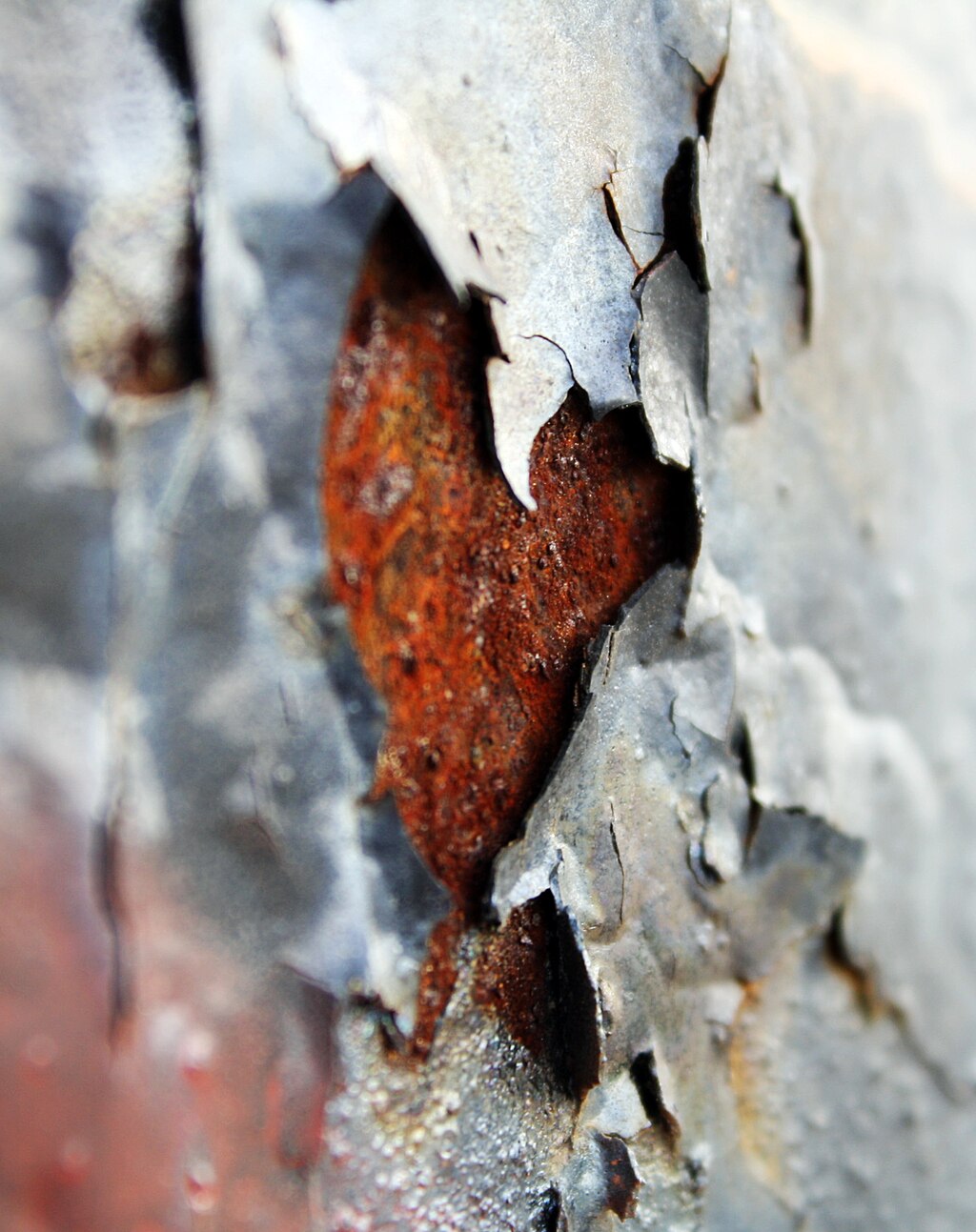
When a metal slowly combines with oxygen in its environment to form a metal oxide, that's corrosion. The most familiar example is rusting:
4Fe(s)+3O2(g)⟶2Fe2O3(s)
Word form: iron + oxygen → iron oxide.
Rusting also needs water (moisture from air, rain, or humidity) — without it, dry iron in pure oxygen barely rusts. The equation above captures the atom-bookkeeping; water is a helper that lets the reaction proceed at normal temperatures.
Rust (iron(III) oxide) forming on iron. This slow synthesis reaction happens whenever iron meets oxygen and moisture.
Source — Wikimedia Commons (public domain)
Signature of synthesis: 2 or more reactants → 1 product.
Pattern 2 — Decomposition (break down)
One compound breaks down into two or more simpler substances. This nearly always needs energy — heat, light, or electricity.
Decomposition: one compound splits into two separate particles.
General form:
AB⟶A+B
Real example — hydrogen peroxide (the textbook's lead decomposition):
2H2O2(aq)catalase▶2H2O(l)+O2(g)
(The enzyme catalase, found in liver and blood, sits above the arrow because it's a catalyst — it speeds up the reaction without being consumed. The reaction happens without a catalyst too, just much slower.)
Word form: hydrogen peroxide → water + oxygen.
H₂O₂ is also a familiar household chemical — diluted forms are sold as antiseptic, mouthwash, hair bleach, and disinfectant. It slowly decomposes on a shelf (which is why old bottles lose strength); a catalyst just speeds it up.
Signature of decomposition: 1 reactant → 2 or more products.
Decomposition needs energy — from one of three sources
Type
Energy source
Example
🔥 Thermal
Heat
CaCO3(s)heat▶CaO(s)+CO2(g)
⚡ Electrical (electrolysis)
Electricity
2H2O(l)electricity▶2H2(g)+O2(g)
☀️ Photochemical
Light / UV
2AgBr(s)light▶2Ag(s)+Br2(l) (silver bromide breaks down in sunlight — the reaction photographic film is based on.)
Writing equations — two levels of detail
Level
Example
When to use
Word equation
iron + oxygen → iron oxide
Talking to non-scientists; showing what substances are involved.
Symbol equation
4Fe(s)+3O2(g)⟶2Fe2O3(s)
Doing chemistry properly — atoms, counts, states, and conditions above the arrow.
💡 Balancing rule (preview): the number of atoms of each element must be the same on both sides. We'll practise balancing next lesson — today, just try to notice that the numbers on both sides already match in the examples above.
Science as a human endeavour · VC2S10H04
Why does a weather presenter on TV say "nitrogen and oxygen form smog" instead of "N2(g) + O2(g) → 2NO(g)"? Scientists deliberately choose different ways of communicating the same idea depending on the audience. For the general public, a word equation gives the gist without scary-looking symbols. For other chemists, a balanced symbol equation carries precise information about atoms, states, coefficients, and conditions — details a working chemist needs to actually reproduce the reaction in a lab. Neither is "better". Each is built for its job.
Key terms
Keywords
synthesis reaction
Two or more substances combine to form one new compound (A + B → AB).
decomposition reaction
One compound breaks down into two or more simpler substances (AB → A + B).
corrosion
A synthesis reaction where a metal combines with substances in its environment — oxygen, moisture — to form new compounds.
rusting
The specific corrosion of iron (and iron-based alloys like steel, which is mostly iron). Other metals corrode but we don't call it rusting — copper goes green (patina), silver darkens (tarnish), aluminium forms a protective oxide layer. "Rust" is reserved for the reddish-brown iron(III) oxide.
word equation
A reaction written with substance names and an → arrow.
symbol equation
A reaction written with chemical formulas (e.g. H₂O, CO₂). Shows atoms and coefficients exactly.
state symbol
(s) solid, (l) liquid, (g) gas, (aq) dissolved in water. Written small after each formula.
coefficient
The big number in front of a formula that tells you how many units. Example: the "2" in 2H₂O.
⚠Watch out · common traps
1
Trap 1
“Decomposition always needs heat.”
Wrong — heat is just one of three energy sources. Real examples of the other two:
2AgBr(s)light▶2Ag(s)+Br2(l)
Silver bromide breaks down in sunlight into silver and bromine — literally how old photographic film worked.
2H2O(l)electricity▶2H2(g)+O2(g)
Pure water splits into hydrogen and oxygen when you pass electricity through it (electrolysis — industry uses it to make hydrogen fuel).
Rule: any of heat / light / electricity can drive decomposition. You always need an energy source — it just doesn't have to be heat.
2
Trap 2
“Mixing salt and water makes salt water — that's synthesis.”
Wrong — dissolving is a physical change, not a chemical reaction. The salt and water keep their identities; you can recover the salt by evaporating the water.
True synthesis creates a new compound with different chemistry from the starting materials:
2H2(g)+O2(g)⟶2H2O(l)
The product (water) is a different substance from either reactant (hydrogen gas, oxygen gas).
Rule: synthesis = a chemical reaction where 2+ reactants form 1 NEW compound. If you can recover the starting materials by simple physical means (filtering, evaporating, magnet), it wasn't a chemical reaction.
3
Trap 3
“Rusting only happens by the sea / in salt water.”
Wrong — rusting needs iron + oxygen + water. It happens anywhere there's moisture: rain, dew, condensation, kitchen humidity. Salt water just speeds it up (the dissolved ions help carry electrons), but it's not required.
A nail in a damp shed will rust the same way as one on a salty pier — just slower. Dry desert air is what really slows rusting (which is why ancient iron tools survive better in arid climates than in humid ones).
Rule: rusting needs Fe + O₂ + H₂O. Salt accelerates, but doesn't create.
03
Apply
25 min
Work through all four questions. Each one uses a different format to keep you thinking. Then open Ch 4 Booklet pp.88–89 and do the synthesis + decomposition section on paper.
Question 1Classify the reaction
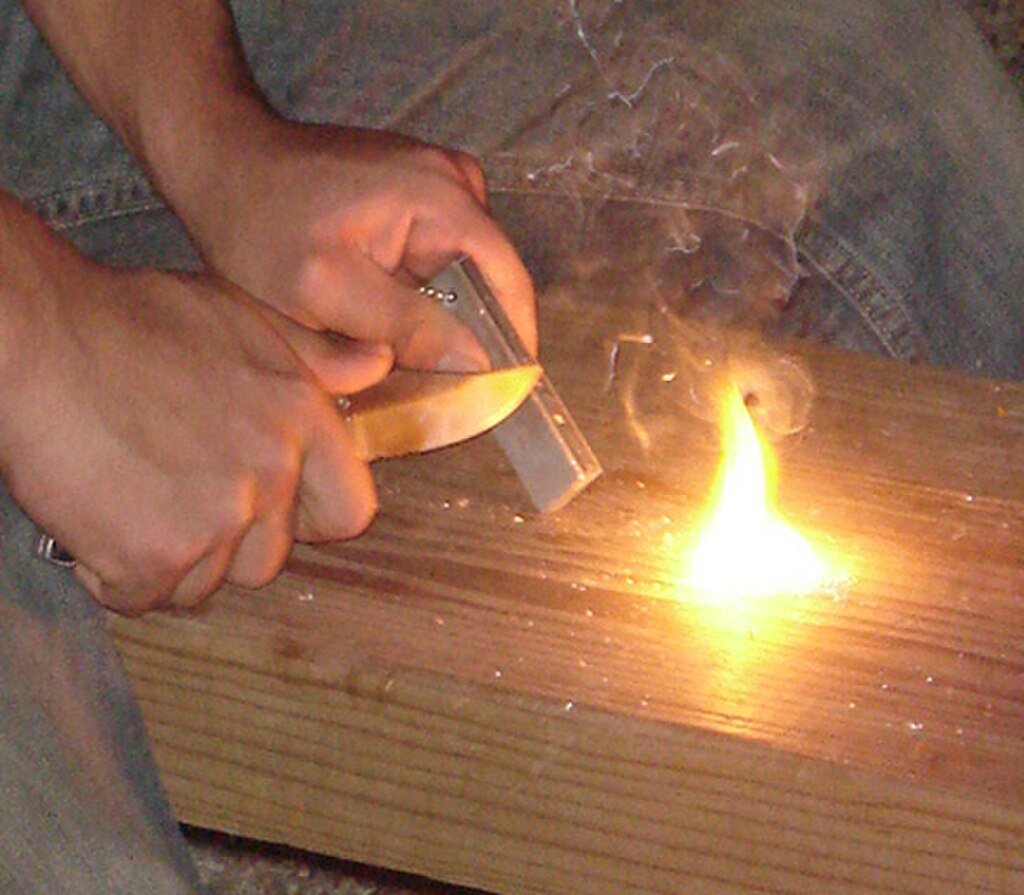
Magnesium burns with a brilliant white light — so bright it was used in the earliest camera flashes.
Source — Wikimedia Commons (public domain)
Question 2Complete the equation
Calcium carbonate (the main component of limestone) is heated in a kiln. It breaks down into calcium oxide and carbon dioxide gas.
Fill in the blanks to complete the word equation:
Now, the same reaction as a symbol equation (note the state symbols, and the "heat" written above the arrow — that's how chemists show what drives the reaction):
CaCO3(s)heat▶CaO(s)+CO2(g)
Then decide in your notebook: is this synthesis or decomposition? Which of the three types of decomposition is it?
(Answer: decomposition — one reactant breaks into two products. Specifically thermal decomposition since heat is written above the arrow.)
Question 3Explain the dark bottle
Pharmacies store some medicines in dark brown bottles because sunlight breaks them down into useless (or even harmful) products.
▸Your turnShort answer · Have a go first
Name the type of reaction sunlight is causing, name the specific subtype of that reaction, and explain why a dark bottle helps.
Question 4Match reaction to energy source
04
Catch
5 min
Fill in the blanks to summarise what you learned about synthesis and decomposition.
Bonus (if you want to stretch): write the balanced symbol equation for sodium + chlorine → sodium chloride. Hint: sodium is Na, chlorine gas is Cl₂, sodium chloride is NaCl.
05
Reflect
10 min
▸Your turnReflect · One thing you learned
One thing I now understand about synthesis or decomposition reactions that I didn't understand before:
Learning Ladder — where are you right now?
Next class (Tue 28 Apr, P4): we go deeper on decomposition using the textbook's lead example — hydrogen peroxide breaking down — and we'll start balancing chemical equations properly.