Factors that affect rate of reactions — concentration and catalysts
Last lesson we changed the temperature and the surface area. Today we close the §4.6 block with the remaining two rate factors: concentration (how many reactant particles are packed into a given volume) and a catalyst (a substance that speeds reactions up without being used up at all).
Learning Intentions + Success Criteria
LITo explain how concentration and catalysts change reaction rate, using collision theory.
SC: I can:
01I can describe and predict the effect of increasing concentration on rate (more particles per unit volume).
02I can describe how a catalyst speeds up a reaction by lowering activation energy without being consumed.
03I can apply both factors to everyday examples (e.g. dilute vs concentrated acid; amylase as a biological catalyst).
01
Engage
5 min
↺Quick recap · from last class
L16 · §4.6 Factors that affect rate of reactions — temperature and surface area
Try these 2questions before today's new content. Click an answer for instant feedback — your teacher will walk through them with you.
Two beakers contain the same mass of marble chips at the same temperature. Beaker A: filled with dilute hydrochloric acid. Beaker B: filled with concentrated hydrochloric acid (same volume). Which beaker reacts faster, and why?
02
Explicit
17 min
Today's procedure — predicting effect of [c] or catalyst on rate
START — you change concentration or add a catalyst; what happens to the rate?
↓
1. Which factor?
↓
↓ Concentration ↑
One effect: More particles per volume → more collisions/sec. Each collision's energy is unchanged.
→ Rate ↑
↓ Catalyst added
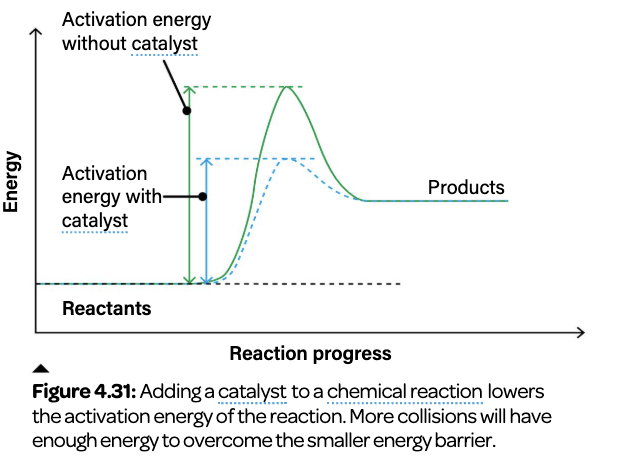
Catalyst lowers the activation energy (Eₐ). More collisions clear the smaller barrier per second. Catalyst is not used up.
→ Rate ↑↑ (often a big jump)
Same logic as L13: identify what you changed, then trace it through collision theory to the rate. Pressure ↑ on a gas works the same as concentration ↑.
Four factors that change reaction rate — closing the §4.6 block
You met all four in L11 (collision theory). L13 took the first two; today closes the block.
Factor
Easy to control?
Everyday handle
Temperature
yes
fridge vs kitchen bench (L13)
Surface area
yes
whole vs crushed solid (L13)
Concentration(today)
yes
dilute vs concentrated acid
Catalyst(today)
needs the right substance
enzymes, catalytic converters
Concentrated substances react more quickly
Concentration is how many particles are packed into a given volume of solution or gas. Push concentration up and the rate goes up — here is the chain:
More reactant particles per unit volume.
Crowded particles collide more often with each other.
More collisions per second ⇒ more successful collisions per second ⇒ faster rate.
Figure 4.27 — Same volume, more particles. Higher concentration means particles collide more often, so the rate goes up.
Catalysts increase the rate of reaction
A catalyst speeds up a reaction by lowering its activation energy — the energy hump particles must clear before they react. The catalyst itself is not used up. When writing the equation we put the catalyst above the arrow to show it is present but not consumed (Figure 4.31).
Catalysts are specific, which means that a catalyst increases the rate of some reactions but not others. Catalysts are important in industry because they reduce reaction times and enable chemical processes to take place at lower temperatures and pressures. Therefore, they reduce the cost of production of valuable products.
Enzymes are biological catalysts. They are proteins that help speed up chemical reactions in the body. For example, amylase in saliva catalyses the breakdown of carbohydrates in your mouth.
Key terms
Keywords
concentration
How many particles of a substance are packed into a given volume of solution or gas.
catalyst
A substance that increases the rate of a chemical reaction without being used up.
enzyme
A biological catalyst that increases the rate of reactions in cells.
activation energy
The minimum energy a collision must have for the reaction to occur.
⚠Watch out · common traps
1
Trap 1
“Adding water to an acid makes it react faster.”
Wrong — diluting lowers the concentration of acid particles per unit volume, so collisions per second go down and the reaction goes slower.
If there are fewer acid particles in the same volume, there are fewer collisions with the marble chips each second, so the fizzing is slower.
Rule: dilution slows the reaction; concentration ↑ speeds it.
2
Trap 2
“A catalyst is consumed by the reaction it speeds up.”
Wrong — the defining feature of a catalyst is that it is NOT consumed. In a chemical equation, the catalyst is often written above the arrow to show it is present but not one of the reactants or products.
A catalyst is regenerated at the end of every individual reaction it speeds up. Same amount before and after.
Rule: catalyst in = catalyst out. If it's used up, it's a reactant, not a catalyst.
3
Trap 3
“A catalyst makes more product form.”
Wrong — a catalyst changes how fast the reaction goes, not how much product you get.
The amount of product is limited by how much reactant is available. A catalyst only changes the rate — you reach the same final amount sooner.
It also doesn't change whether the reaction is exothermic or endothermic. Catalysts only lower Eₐ; they don't shift where the reactants and products sit on the energy axis (you'll see this in §4.7).
Fill in the blanks to complete the textbook definition of a catalyst.
Question 3Catalysts in the body
▸Your turnShort answer · Have a go first
Enzymes are biological catalysts. (a) Where in the body would you find amylase, and what reaction does it catalyse? (b) Why is it useful to have biological catalysts in the body rather than relying on the unaided rate of these reactions?
Question 4Match the change to the effect on rate
04
Catch
5 min05
Reflect
10 min
▸Your turnReflect · One thing you learned
One thing I now understand about concentration or catalysts that I didn't understand at the start of the lesson:
Success criteria — where are you right now?
Next class (Wed 20 May, P5): §4.7 — exothermic and endothermic reactions and energy profile diagrams (the merged L15+L16 lesson).