Mathematics / Year 11 Methods / Lesson 1 Year 11 Methods · Lesson 01 of 04 · 60 minutes
Algebra with meaning Which changes preserve the value of an expression or the solutions of an equation?
By the end, you can… Expand and factorise with a reason for each step. Solve equations and check the result in the original equation. Retain restrictions when simplifying a fraction. Skills to bring Signed arithmetic Fraction operations The distributive law 01 · 8 minutes · Start without a calculator
Warm up Try these in your notebook. Use the answers to spot anything to revisit.
Evaluate 3 ( x − 2 ) 3(x-2) 3 ( x − 2 ) x = 4 x=4 x = 4
Show worked answer 6 6 6
Substitute before calculating: 3 ( 4 − 2 ) = 6 3(4-2)=6 3 ( 4 − 2 ) = 6
Calculate 3 4 + 1 6 \frac34+\frac16 4 3 + 6 1
Show worked answer 11 12 \frac{11}{12} 12 11
Use denominator 12: 9 12 + 2 12 = 11 12 \frac9{12}+\frac2{12}=\frac{11}{12} 12 9 + 12 2 = 12 11
Solve 2 x + 5 = 17 2x+5=17 2 x + 5 = 17
Show worked answer x = 6 x=6 x = 6
Subtract 5, then divide by 2.
02 · 12 minutes · Think, then discuss
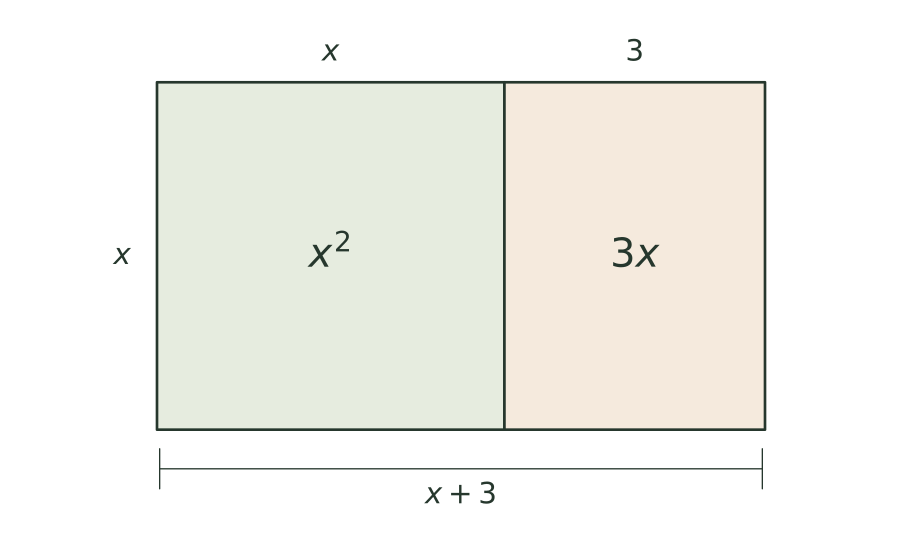
Test the step, not just the answer Use the rectangle to explain x ( x + 3 ) = x 2 + 3 x x(x+3)=x^2+3x x ( x + 3 ) = x 2 + 3 x
Area connects the product x ( x + 3 ) x(x+3) x ( x + 3 ) x 2 + 3 x x^2+3x x 2 + 3 x Open full-size figure ↗ 3 ( x − 2 ) = 3 x − 2 3(x-2)=3x-2 3 ( x − 2 ) = 3 x − 2 x 2 − 9 = ( x − 3 ) ( x + 3 ) x^2-9=(x-3)(x+3) x 2 − 9 = ( x − 3 ) ( x + 3 ) x 2 − 9 x − 3 = x + 3 \frac{x^2-9}{x-3}=x+3 x − 3 x 2 − 9 = x + 3 Compare your reasoning The first is false: at x = 2 x=2 x = 2 3 x − 6 3x-6 3 x − 6
The second is an identity: expanding the right side gives x 2 − 9 x^2-9 x 2 − 9
The third requires x ≠ 3 x\ne3 x = 3
Expressions and equations An expression has a value for each allowed input. An equation asks which inputs make two expressions equal.
Null factor law A product is zero only when at least one factor is zero.
A B = 0 ⟹ A = 0 or B = 0 AB=0\ \Longrightarrow\ A=0\ \text{or}\ B=0 A B = 0 ⟹ A = 0 or B = 0 Cancel factors Factor the numerator and denominator first. State every excluded input before cancellation.
A B A = B ( A ≠ 0 ) \frac{AB}{A}=B\quad(A\ne0) A A B = B ( A = 0 ) 03 · 15 minutes · Explain each step
Work it through Worked example 1
Solve by factorising Solve x 2 − 5 x + 6 = 0 x^2-5x+6=0 x 2 − 5 x + 6 = 0
Find two numbers with product 6 and sum − 5 -5 − 5 − 2 -2 − 2 − 3 -3 − 3 x 2 − 5 x + 6 = ( x − 2 ) ( x − 3 ) x^2-5x+6=(x-2)(x-3) x 2 − 5 x + 6 = ( x − 2 ) ( x − 3 ) By the null factor law, x = 2 x=2 x = 2 x = 3 x=3 x = 3 Both values give zero in the original equation. Worked example 2
Simplify without losing the domain Simplify x 2 − 9 x − 3 \frac{x^2-9}{x-3} x − 3 x 2 − 9
The original denominator requires x ≠ 3 x\ne3 x = 3 x 2 − 9 x − 3 = ( x − 3 ) ( x + 3 ) x − 3 = x + 3 \frac{x^2-9}{x-3}=\frac{(x-3)(x+3)}{x-3}=x+3 x − 3 x 2 − 9 = x − 3 ( x − 3 ) ( x + 3 ) = x + 3 The result is x + 3 x+3 x + 3 x ≠ 3 x\ne3 x = 3 x + 3 x+3 x + 3 04 · 20 minutes · Work by hand, then check
Try it yourself Start with questions 1–4. Continue to 5–6 if time allows, or finish them after class. Show your reasoning before opening an answer.
Expand and simplify − 2 ( x − 3 ) + 4 x -2(x-3)+4x − 2 ( x − 3 ) + 4 x
Show worked answer 2 x + 6 2x+6 2 x + 6
− 2 x + 6 + 4 x = 2 x + 6 -2x+6+4x=2x+6 − 2 x + 6 + 4 x = 2 x + 6
Factorise 2 x 2 − 8 x 2x^2-8x 2 x 2 − 8 x
Show worked answer 2 x ( x − 4 ) 2x(x-4) 2 x ( x − 4 )
Take out the common factor 2 x 2x 2 x
Solve ( x − 3 ) ( x + 2 ) = 0 (x-3)(x+2)=0 ( x − 3 ) ( x + 2 ) = 0
Show worked answer x = 3 x=3 x = 3 x = − 2 x=-2 x = − 2
Set each factor equal to zero.
Solve 3 x − 1 4 = x + 5 2 \frac{3x-1}{4}=\frac{x+5}{2} 4 3 x − 1 = 2 x + 5
Show worked answer x = 11 x=11 x = 11
Multiply by 4: 3 x − 1 = 2 x + 10 3x-1=2x+10 3 x − 1 = 2 x + 10 x = 11 x=11 x = 11
Simplify x 2 − 16 x + 4 \frac{x^2-16}{x+4} x + 4 x 2 − 16
Show worked answer x − 4 x-4 x − 4 x ≠ − 4 x\ne-4 x = − 4
Factorise as ( x − 4 ) ( x + 4 ) (x-4)(x+4) ( x − 4 ) ( x + 4 )
A rectangle has width x x x ( x + 3 ) (x+3) ( x + 3 ) 28 m 2 28\text{ m}^2 28 m 2
Show worked answer 4 m 4\text{ m} 4 m 7 m 7\text{ m} 7 m
x ( x + 3 ) = 28 x(x+3)=28 x ( x + 3 ) = 28 ( x + 7 ) ( x − 4 ) = 0 (x+7)(x-4)=0 ( x + 7 ) ( x − 4 ) = 0
Only x = 4 x=4 x = 4 x = − 7 x=-7 x = − 7
Quick checks Choose an answer, then check your reasoning.
05 · 5 minutes · An independent check
Exit ticket Close your notes and try both questions. Then write one idea you can explain and one question you still have.
Factorise x 2 + x − 12 x^2+x-12 x 2 + x − 12
Show worked answer ( x + 4 ) ( x − 3 ) (x+4)(x-3) ( x + 4 ) ( x − 3 )
The factors need product − 12 -12 − 12
A student writes x 2 + x x = x + 1 \frac{x^2+x}{x}=x+1 x x 2 + x = x + 1 x x x
Show worked answer The restriction x ≠ 0 x\ne0 x = 0
The original denominator is zero at x = 0 x=0 x = 0
Keep the idea working
After class Finish any remaining practice, then try these two follow-up questions.
Solve x 2 − 7 x + 10 = 0 x^2-7x+10=0 x 2 − 7 x + 10 = 0
Show worked answer x = 2 x=2 x = 2 x = 5 x=5 x = 5
( x − 2 ) ( x − 5 ) = 0 (x-2)(x-5)=0 ( x − 2 ) ( x − 5 ) = 0
Simplify x 2 − 25 x − 5 \frac{x^2-25}{x-5} x − 5 x 2 − 25
Show worked answer x + 5 x+5 x + 5 x ≠ 5 x\ne5 x = 5
Factor the difference of squares.
Mark complete when you have attempted the practice and checked your exit ticket.